
The morning workbound heading south toward Edmonds on the Sounder.
The morning workbound heading south toward Edmonds on the Sounder.

A freight headed south on the left, the Sounder heading north on the right. Two thirty-second exposures combined.

128th Street SW, less than a mile from my house. 16 cars involved, 2 injured critically. Fortunately, I got a message through to Camille so she could totally avoid this mess. Ordinarily, she drives right through here to get home.


Seen along Mukilteo Speedway:

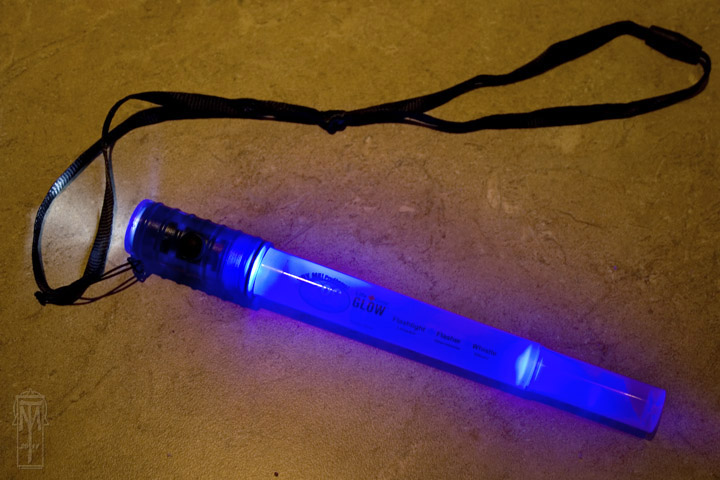 Home Depot has these flashlight/glowsticks in three colors for $4. I picked up a blue one, and now that it is getting dark so early, I carry it along on our evening walks.
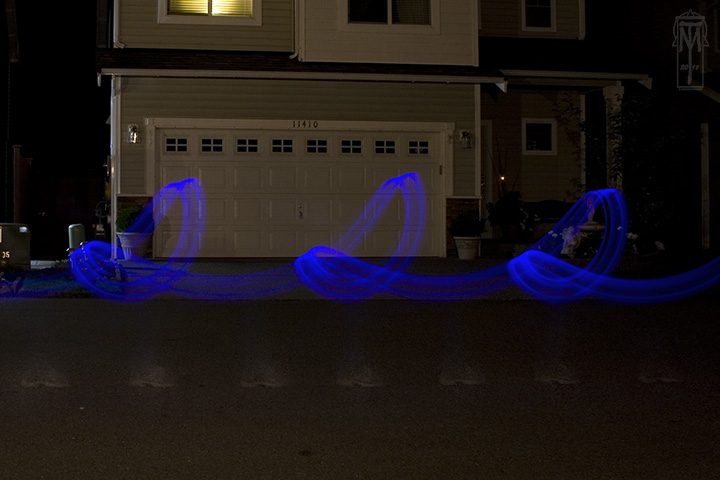
I turn on the glowstick when we approach intersections, as we have nearly been run over by inattentive/careless drivers on more than one occasion.
It isn’t a failsafe, but it certainly commands a little more attention.

 Methinks it is no accident that all the trees planted in the Home Depot parking lot turn to the company colors every year.
Lets talk about these goddamned hose bibs that are supposed to be frost proof.
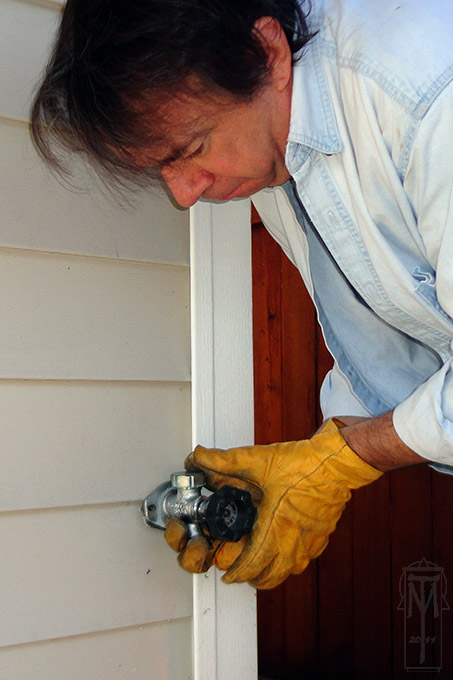 Like a shocking number of other things in our 5-year-old home, one of the outdoor faucets decided to give up the ghost.
Unfortunately, it is no longer a simple case of unscrewing the faucet and replacing it with a newer, higher quality one. These “new and improved” outdoor faucets come in no less than 6 lengths (4″, 6″, 8″, 10″, 12″, and 14″) and 3 sizes (1/2″, 3/4″ and 1″ thread). For those of you playing the “What’s My Probability” home game, that gives you a 4.17% chance that you can guess the right size (95.83% that you are luckless), as the manufacturers are not intelligent enough to imprint the specs anywhere on the faucet. I’d rather know what I am dealing with, have the new part purchased and on site before I take the faucet off and leave the PEX dripping slowly inside the wall. But noooo. (My Lean Six Sigma instructor, with her ready grin and endearing Midwestern charm, would probably say, “Oh! Lots of opportunities for improvement!”)
First, I try to figure out if I can just replace the guts, and leave the sleeve in place. I shut off the water and drained the house, because OF COURSE the faucet that fails is always going to be at lowest point in the entire plumbing system. Then I took the faucet apart, trotted over to Home Despot, and picked out a shiny new faucet that looked to be identical: $32 plus tax.
Back home, I wrenched it open and discovered that it was just different enough that nothing was interchangeable with my leaking one. In this process, I discovered that the only thing wrong with my existing faucet was a 17 cent rubber washer that had worn out. I spent part of an afternoon being told by three different plumbing supply houses that these rubber washers are simply not available. WTF!
OK. I have no choice but to replace the whole shebang. Now I worry. Did the monkeys who slapped this house together properly attach the PEX fixture inside the wall, or am I going to have a broken mess inside the wall when I wrench on this faucet to remove it? In the worst-case scenario, I know what is inside walls, and how to repair almost anything that happens to drywall, so it will just be a pain in an unreachable place, not something unrecoverable, if the PEX connection fails. On the other hand, I know what it is going to feel like if a plumber walks up to the faucet, unscrews it (without a wrench, of course), pulls a new sillcock out of his back pocket, screws it in, then smirks at me like I’m the biggest schmuck in Washington State as he hands me a bill for $400.
I’m a man. I decide to let the dice fly high.
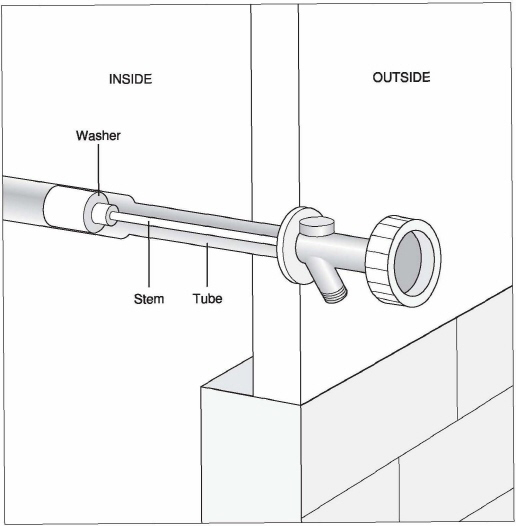
The operating principle behind frost proof sillcocks is that the valve that actually stops the flow of water is six or more inches inside the building – inside the wall, theoretically away from cold temperatures. When the water is turned off, the water remaining in the sleeve is supposed to drain out, leaving nothing within reach of mean old Old Man Winter.
Unfortunately, if you leave a garden hose attached to the sillcock, this defeats the entire purpose, as the water does not drain out and the sleeve ruptures at the first freeze.
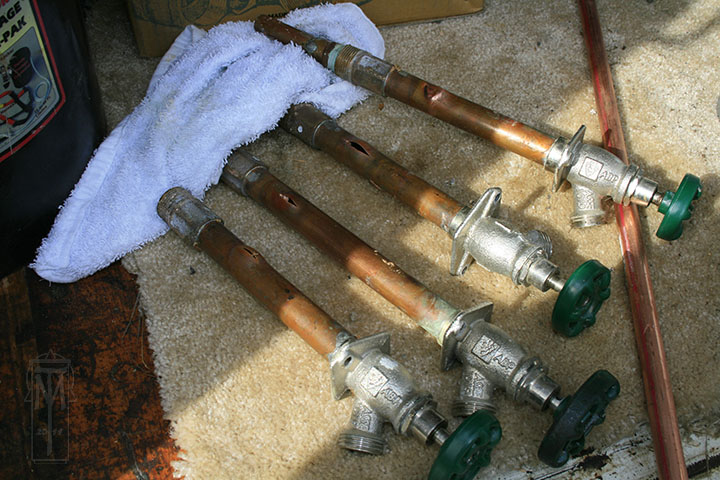 Last fall, I ran into a plumber on his rounds after a day of changing these things in a development. Apparently, quite a few people don’t know that you have to disconnect your garden hose in the fall.
You can see all four have burst open toward the rear, which means they filled up the inside of the walls for however long it was until the homeowner realized there was water running somewhere. (Click on the image to enlarge.)
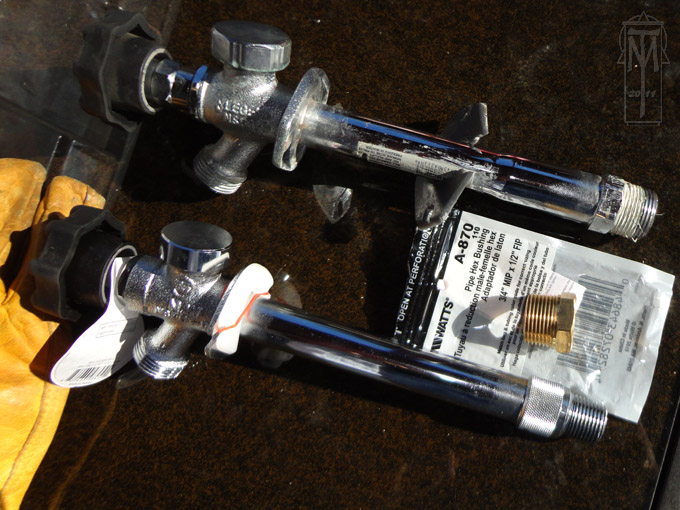
Back at our patio, slowly the faucet breaks loose, and soon enough I pull it free, only to discover that the replacement does not fit – the sillcocks available at Lowe’s and Home Depot are 1/2″ thread (image bottom), but my house needs a 3/4″ model (image top). So, I saddle up again and ride back over to Home Despot for a bushing (image center).
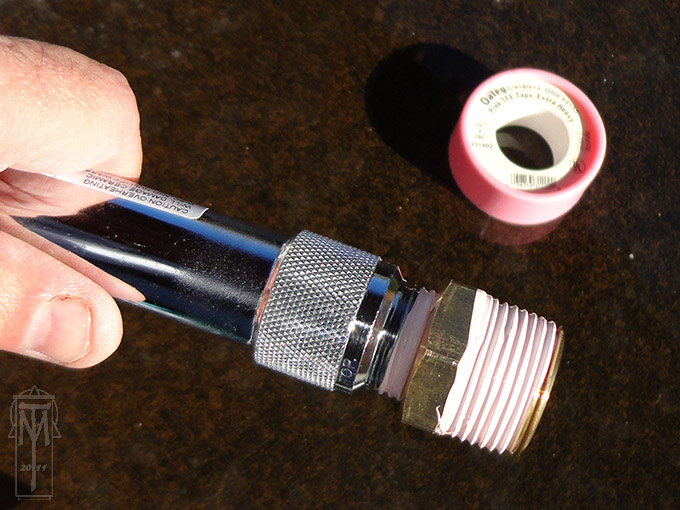
Bushing installed, with Teflon tape, of course. The tape is not “gilding the lily,” it’s insurance against poorly machined threads and sloppy tolerancing in mass produced fixtures.
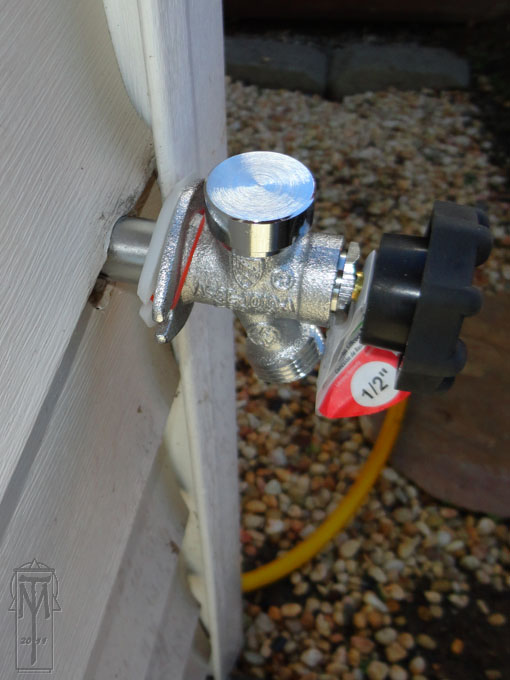
Of course, this adds length to the sillcock, which makes it stand proud of the house by almost a full inch.
Nice.
After all the care and effort, it still looks like a job done by a motard.
It still remains to be seen if I successfully got it threaded squarely and securely tightened, or if I have a nasty surprise awaiting me, in, say, three months or so when the interior wall in the downstairs studio gives way from flood rot.
Oh well. Let the dice fly high.
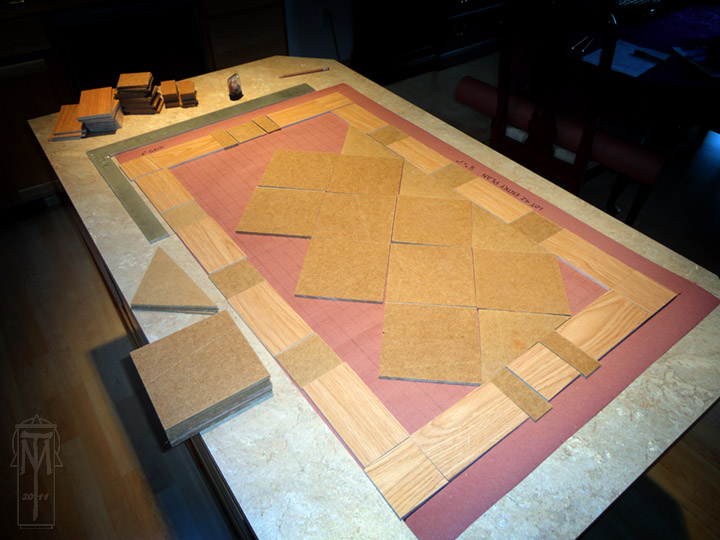
The next project begins! To tile the entry, I am creating a half-size mockup in order to decide on a pattern.
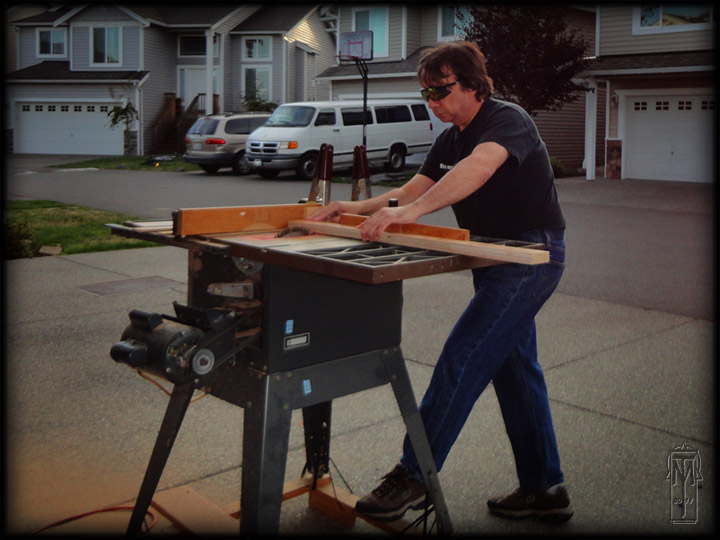
Cutting blanks:
Preliminary layout on rosin paper, scored with a 1″ grid. The “tiles” are scrap hardboard cut to scale of actual tile sizes. The beauty of this method is that we get to arrange and rearrange and visualize with a great deal of certainty and a minimum of guesswork:

When a final design is settled on, I can make an accurate supply list from the mockup:


Fortunately, I own three sets of Phillips head screwdrivers: SAE, ISO and Reed & Prince. Reed & Prince are the choice of furniture manufacturers.
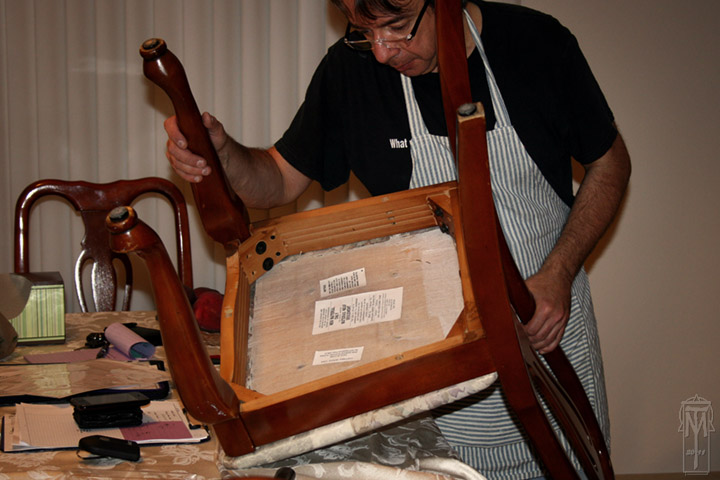 I always cringe a little when I see people treating Phillips drivers interchangeably – as if a #1 SAE driver should work just fine in a #2 ISO screw.
It gets even funnier when folks chuck a bit into a power drill, and make those chattering hammer-drill sounds as they grind the bit into a scratch awl, and the screw head into a divot.
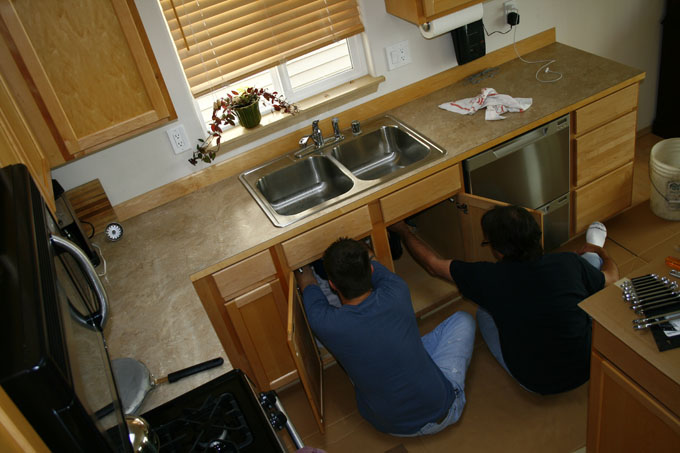 Our home came with a double basin stainless steel sink in the kitchen, which Camille hated. It was not big enough to wash anything that was too big to fit in the dishwasher – roasting pans, large pots, my Wakizashi, and so on.
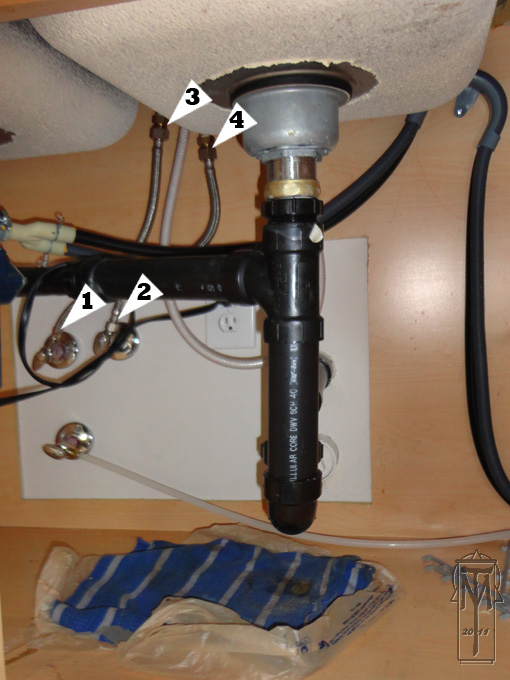
The builder, Cornerstone Homes (“Corner” stands for the corners they cut), never completed the installation of the sink. The sink itself did not have a single clip holding it in, and when we replaced the sink, we discovered the water connections were only finger tight. The trap had a small leak that I could not find, which began just after the warranty period ran out. I suppose it is because we are so terribly hard on our possessions that the faucet had recently begun to leak, so we changed that as well. This time, we selected a unit that cost a little more than the $4.99 Cornerstone homes apparently spent on the old one.
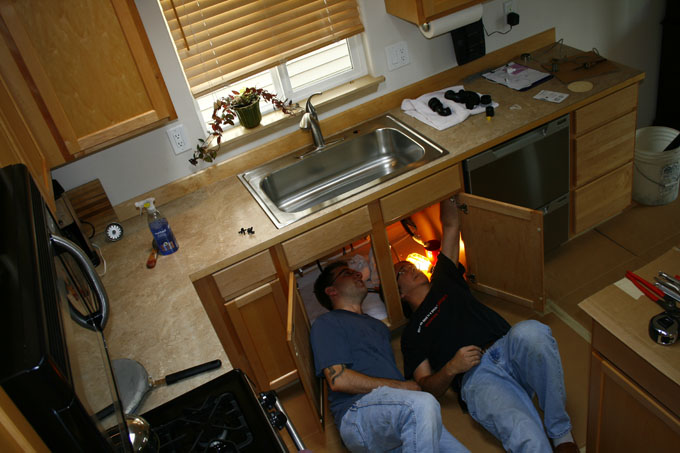
Over the past five years, there were many times that we smelled a horrid stench coming from the sink, and we could not figure out what it was. It turns out that the in-sink garbage disposal was such a cheap piece of crap that it was not grinding the garbage well enough to go out the drain, so there was always a collection of rotting food and debris in the throat of the disposal. We replaced it with a Kitchen-Aid, which is so incredibly quiet that you almost cannot tell when it is running.
The installation instructions for the sink and the faucet insist that the only tools you need are a straight slot screwdriver, a 1/2″ open end wrench, a 1/8″ allen wrench, and some plumber’s putty. Always remember that the people who write these instructions are so full of sh!t their eyes are brown.
 You will also need a pair of Channel locks, an adjustable wrench, wire cutters, jig saw, scratch awl, scissors, putty knife, vise grips, utility knife, trouble light, ball peen hammer, drift pin, 3 pound sledge hammer, cold chisel, bench vise, #1 Phillips screwdriver, #3 Phillips screwdriver, tape measure, a caulking gun loaded with silicone adhesive, Teflon tape, ABS cement, 100 grit sandpaper, a bench grinder, rags and paper towels. You also need a working knowledge of material science, so you can overcome the trap doors and dead ends that arise, such as figuring out how to modify the spring steel clips that hold the sink in when you discover that the builder did not leave enough room under the sink to actually use them. (Perhaps that is why the original installation was never completed. More corners cut.)
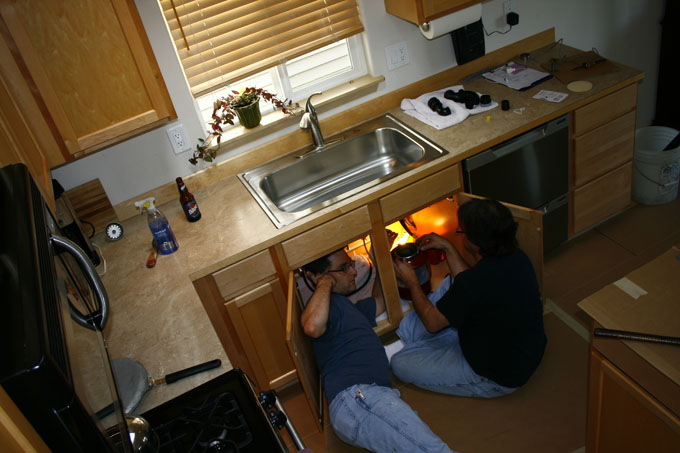 And for the Kitchen Aid garbage disposal, you will need a #2 Phillips screwdriver, large channel locks, wire strippers, a soldering iron, rosin core solder, wire nuts, electrical tape, a strain relief and a polarized power cord. That’s right. A $300 in-sink garbage disposal does not even come with a f*cking power cord. Further, the box had been raided at the store (Judd & Black, Lynnwood), and the spring clamp for the drain port connection was missing. Jeff and I spent the afternoon driving around trying unsuccessfully to find a replacement. I wound up securing the outlet pipe with an industrial grade cable tie.
On the bright side, I got to do one of my favorite things – MODIFICATIONS! Also known as “solving riddles,” or “compensating for the stupidity of others.” Apparently, I chose a perfectly appropriate T-Shirt to begin the day: “What we need is a patch for human stupidity.”
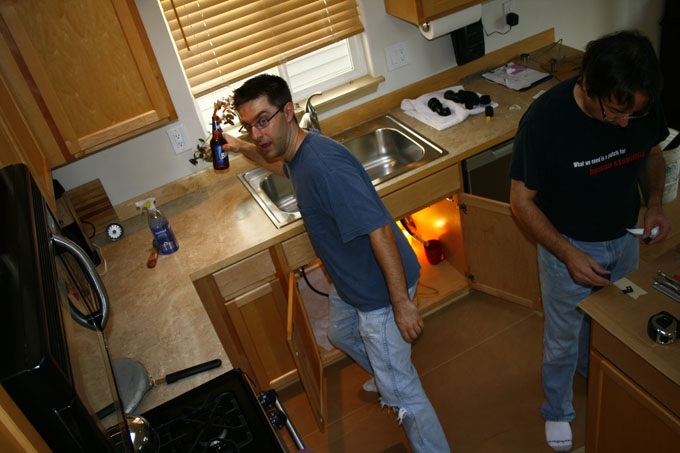 Of course, this was also a fine excuse for the finest time-honored traditions of father-son bonding: bawdy jokes, blue language, pizza and beer. And no matter how much I complain about being forced to deal with the careless ignorance of other “professionals,” I do take pride in being able to improvise, adapt and overcome.
There is an old expression that any home repair project will require at least three trips to the hardware store. But sometimes, it takes less time for me to make my own hardware than it does to drive to Home Depot. Jeff likes to point out that my photos on this project are a catalog of OSHA violations. Sparks raining down on dry wood, no gloves, no goggles (there is a safety shield on the grinder).
 Hey! What kind of adventure would it be without a little danger?
Besides – how else can I possibly justify wearing something as hopelessly un-cool as a shop apron? 😀
Finally, The Supervisor checks our work:
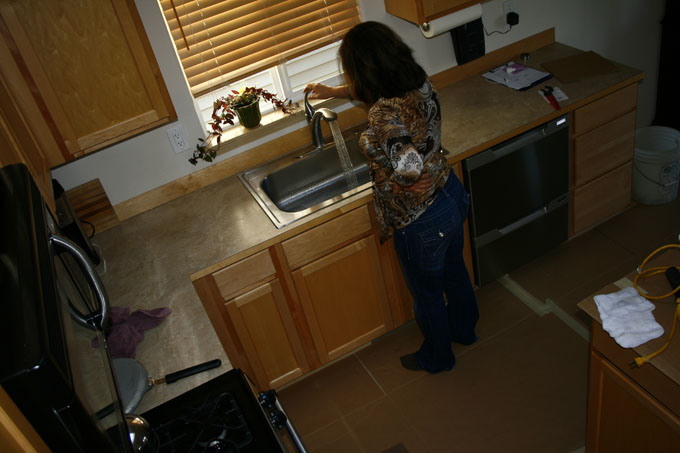
I got a smooch and a pat on the butt. Guess we did OK.
