Lets talk about these goddamned hose bibs that are supposed to be frost proof.
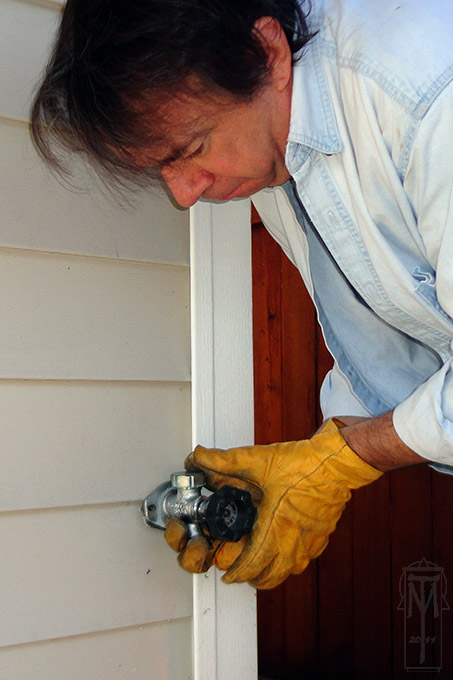 Like a shocking number of other things in our 5-year-old home, one of the outdoor faucets decided to give up the ghost.
Unfortunately, it is no longer a simple case of unscrewing the faucet and replacing it with a newer, higher quality one. These “new and improved” outdoor faucets come in no less than 6 lengths (4″, 6″, 8″, 10″, 12″, and 14″) and 3 sizes (1/2″, 3/4″ and 1″ thread). For those of you playing the “What’s My Probability” home game, that gives you a 4.17% chance that you can guess the right size (95.83% that you are luckless), as the manufacturers are not intelligent enough to imprint the specs anywhere on the faucet. I’d rather know what I am dealing with, have the new part purchased and on site before I take the faucet off and leave the PEX dripping slowly inside the wall. But noooo. (My Lean Six Sigma instructor, with her ready grin and endearing Midwestern charm, would probably say, “Oh! Lots of opportunities for improvement!”)
First, I try to figure out if I can just replace the guts, and leave the sleeve in place. I shut off the water and drained the house, because OF COURSE the faucet that fails is always going to be at lowest point in the entire plumbing system. Then I took the faucet apart, trotted over to Home Despot, and picked out a shiny new faucet that looked to be identical: $32 plus tax.
Back home, I wrenched it open and discovered that it was just different enough that nothing was interchangeable with my leaking one. In this process, I discovered that the only thing wrong with my existing faucet was a 17 cent rubber washer that had worn out. I spent part of an afternoon being told by three different plumbing supply houses that these rubber washers are simply not available. WTF!
OK. I have no choice but to replace the whole shebang. Now I worry. Did the monkeys who slapped this house together properly attach the PEX fixture inside the wall, or am I going to have a broken mess inside the wall when I wrench on this faucet to remove it? In the worst-case scenario, I know what is inside walls, and how to repair almost anything that happens to drywall, so it will just be a pain in an unreachable place, not something unrecoverable, if the PEX connection fails. On the other hand, I know what it is going to feel like if a plumber walks up to the faucet, unscrews it (without a wrench, of course), pulls a new sillcock out of his back pocket, screws it in, then smirks at me like I’m the biggest schmuck in Washington State as he hands me a bill for $400.
I’m a man. I decide to let the dice fly high.
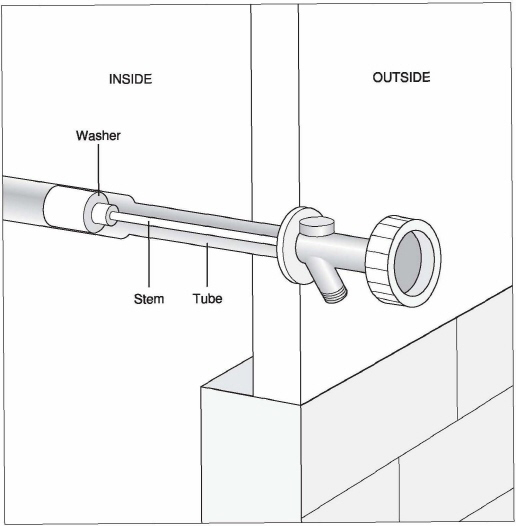
The operating principle behind frost proof sillcocks is that the valve that actually stops the flow of water is six or more inches inside the building – inside the wall, theoretically away from cold temperatures. When the water is turned off, the water remaining in the sleeve is supposed to drain out, leaving nothing within reach of mean old Old Man Winter.
Unfortunately, if you leave a garden hose attached to the sillcock, this defeats the entire purpose, as the water does not drain out and the sleeve ruptures at the first freeze.
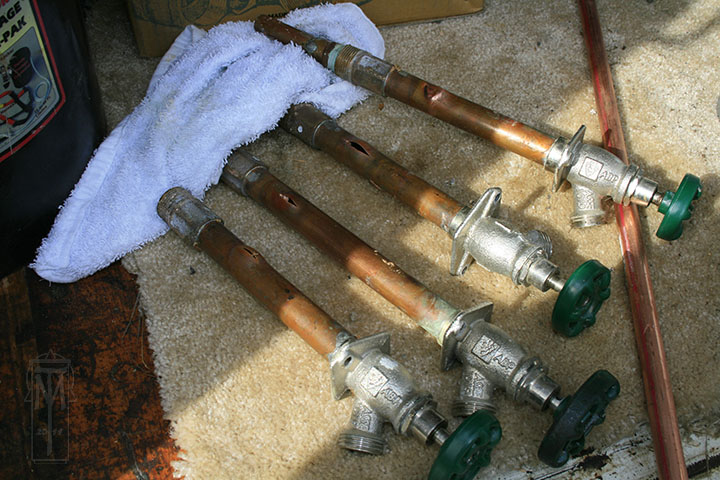 Last fall, I ran into a plumber on his rounds after a day of changing these things in a development. Apparently, quite a few people don’t know that you have to disconnect your garden hose in the fall.
You can see all four have burst open toward the rear, which means they filled up the inside of the walls for however long it was until the homeowner realized there was water running somewhere. (Click on the image to enlarge.)
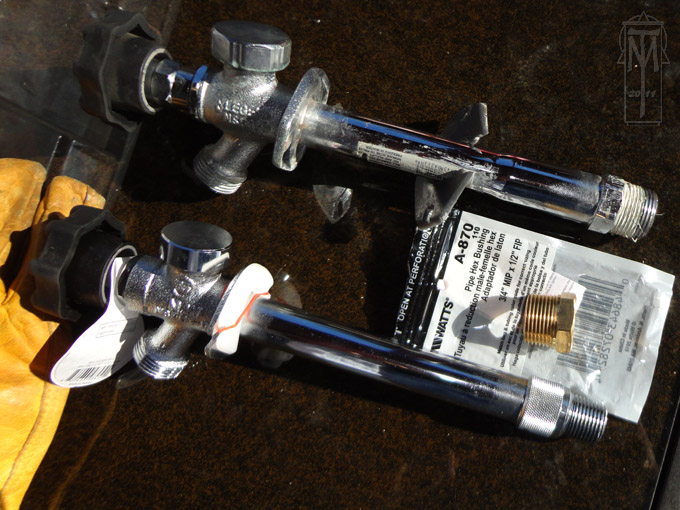
Back at our patio, slowly the faucet breaks loose, and soon enough I pull it free, only to discover that the replacement does not fit – the sillcocks available at Lowe’s and Home Depot are 1/2″ thread (image bottom), but my house needs a 3/4″ model (image top). So, I saddle up again and ride back over to Home Despot for a bushing (image center).
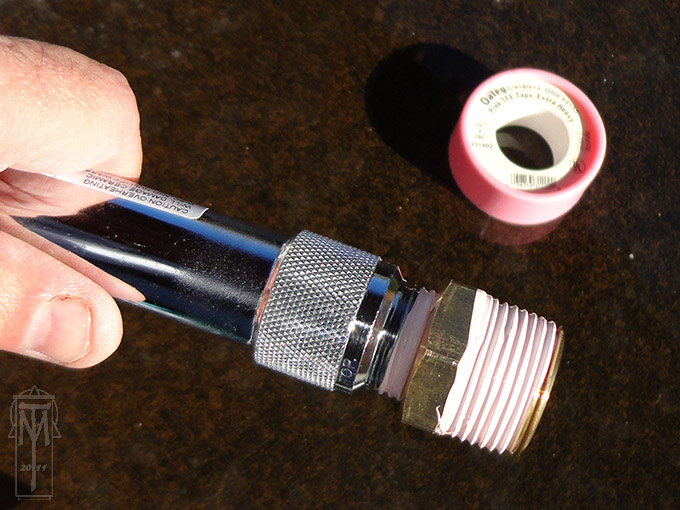
Bushing installed, with Teflon tape, of course. The tape is not “gilding the lily,” it’s insurance against poorly machined threads and sloppy tolerancing in mass produced fixtures.
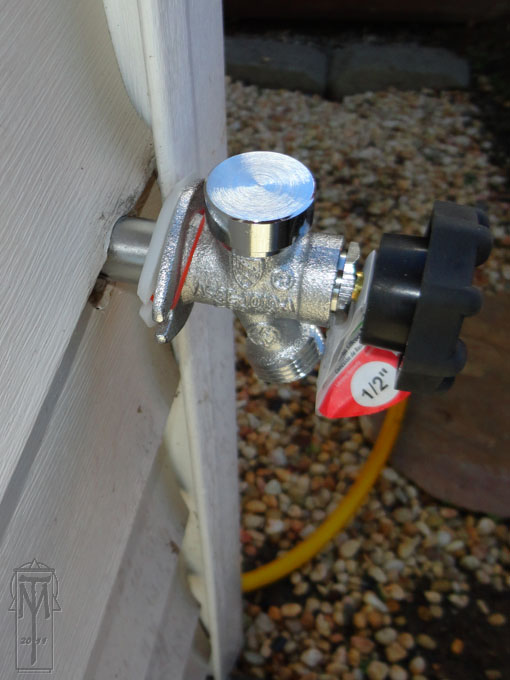
Of course, this adds length to the sillcock, which makes it stand proud of the house by almost a full inch.
Nice.
After all the care and effort, it still looks like a job done by a motard.
It still remains to be seen if I successfully got it threaded squarely and securely tightened, or if I have a nasty surprise awaiting me, in, say, three months or so when the interior wall in the downstairs studio gives way from flood rot.
Oh well. Let the dice fly high.