A few notes about harmonic distortion.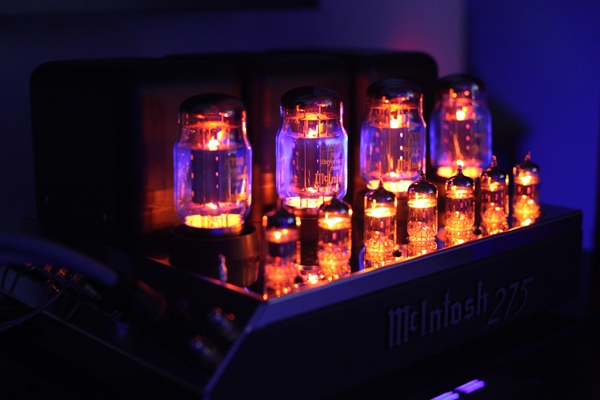
Many people have a clear preference for the type of distortion they like to hear created electronically in music, whether by solid state or tube circuitry.
There are reasons for the differences we hear, as both types of circuits behave differently when driven into clipping.
As gain (amplification) is increased in an amplifier, tubes begin to clip the upper half of the signal before the lower half clips. This asymmetric distortion causes even harmonics, and this type of distortion is generally referred to as “overdrive.”
Solid state (transistor) circuits will tend to clip both the upper and lower halves of the signal symmetrically. Symmetric distortion creates odd-order harmonics and most odd-order harmonics occur at frequencies that are not musically related to the fundamental tone. This is the type of distortion that is generally called “distortion,” and it’s more often heard in hard rock and heavy metal music.
People often tend to find even-order harmonics pleasing and odd-order harmonics harsh. When people insist that analog in general (and tubes in particular) sound “better” than digital systems, what they are really saying is that they prefer hearing the addition of even-order harmonic distortion in their music.
Digital systems generally introduce very little distortion because they are so accurate; so many listeners tend to say they don’t sound as rich or full. It is mostly the lack of even-order harmonic distortions they are noticing. In pro audio, mixing and mastering (but not tracking) engineers will use effects called “exciters” or “enhancers.” These devices are often just glorified even-order harmonic distortion generators.
Harmonic distortion is the introduction of extra harmonics that are musically related to those already present, resulting in a change in timbre. The harmonic content is what determines the timbre of each instrument, which is why an oboe sounds different from an alto sax.
Even-order harmonic distortion tends to sound musically sympathetic, smooth, and bright in a constructive way. Even harmonics are some number of octaves above the original note. For example, for A at 440 Hz:
2nd harmonic: 880 Hz – up one octave
4th harmonic: 1,760 Hz – up two octaves
6th harmonic: 2,640 Hz – up three octaves, and so on.
Even harmonics sound more ‘musical’ because the original note is reproduced one or more octaves higher, like playing a note on a 12-string guitar. As far as harmonic distortion that occurs in electronics is concerned, unless something is broken (intentionally or not) only the 2nd and 3rd harmonics are of great enough amplitude to have a noticeable effect on what you’re hearing.
On the other hand, odd harmonics create dissonance. The 3rd odd harmonic is an octave plus a fifth above the fundamental, and creates a dissonance because, in any given chord, having the 5th of every note is not always appropriate to the chord. A simple example, again using an ‘A’ chord:
A => 3rd harmonic: 1,320 Hz – E above the A at 880 Hz (ok)
C# => 3rd harmonic: 1,660 Hz – G# (not ok for a simple A chord; it’s a major 7th)
E => 3rd harmonic: 1,975 Hz – B (not ok for a simple A chord, it’s a 9th)
When you start adding in 5th, 7th or higher harmonics, it gets much worse. For example, the 5th harmonic of A (440Hz) is 2200 Hz, which is not a note. It falls between C and C# above A at 1,320 Hz. If you do that for all the notes in a chord, you get sonic chaos.
That’s why heavy metal and other music using lots of distortion rely on power chords (Root + 5th) so often – the odd harmonics of chords with additional notes rapidly turn it into noise.