Rosetta was launched by the ESA in 2004, and has sent back images from a couple of asteroids while on its way to 67p. Comet 67p has a velocity of 84,000 mph, and scientists had no idea if the surface was as soft as cigarette ash, or as hard as granite. Landing Rosetta was a lot like tossing a walnut onto a tabletop from 6 yards away.
Good luck with that.
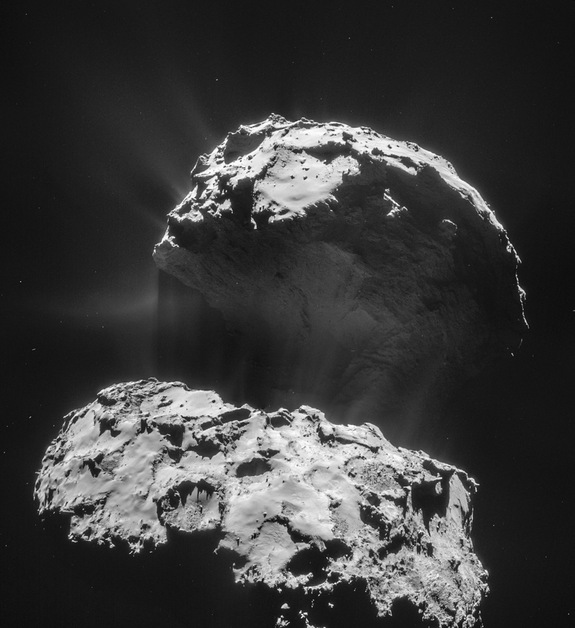 Beyond the technical challenge of hitting such a small target accurately after traveling 4 billion miles over 10 years, I found the results of the chemical analysis to be amazing – apparently, the building blocks of life are present throughout the cosmos, and were possibly brought to earth by comets!
“Complex molecules that could be key building blocks of life, the daily rise and fall of temperature, and an assessment of the surface properties and internal structure of the comet are just some of the highlights of the first scientific analysis of the data returned by Rosetta’s lander Philae last November…
“After the first touchdown at Agilkia, the gas-sniffing instruments Ptolemy and COSAC analyzed samples entering the lander and determined the chemical composition of the comet’s gas and dust, important tracers of the raw materials present in the early Solar System.
“COSAC analyzed samples entering tubes at the bottom of the lander kicked up during the first touchdown, dominated by the volatile ingredients of ice-poor dust grains. This revealed a suite of 16 organic compounds comprising numerous carbon and nitrogen-rich compounds, including four compounds – methyl isocyanate, acetone, propionaldehyde and acetamide – that have never before been detected in comets.
Meanwhile, Ptolemy sampled ambient gas entering tubes at the top of the lander and detected the main components of coma gases – water vapor, carbon monoxide and carbon dioxide, along with smaller amounts of carbon-bearing organic compounds, including formaldehyde.
Importantly, some of these compounds detected by Ptolemy and COSAC play a key role in the prebiotic synthesis of amino acids, sugars and nucleobases: the ingredients for life. For example, formaldehyde is implicated in the formation of ribose, which ultimately features in molecules like DNA.
The existence of such complex molecules in a comet, a relic of the early Solar System, imply that chemical processes at work during that time could have played a key role in fostering the formation of prebiotic material.”
A gif of images made during the landing of Rosetta
A view of the comet from Rosetta
Live comet data
Comet 67p from a distance
Images from Rosetta
More about Comet 67p

