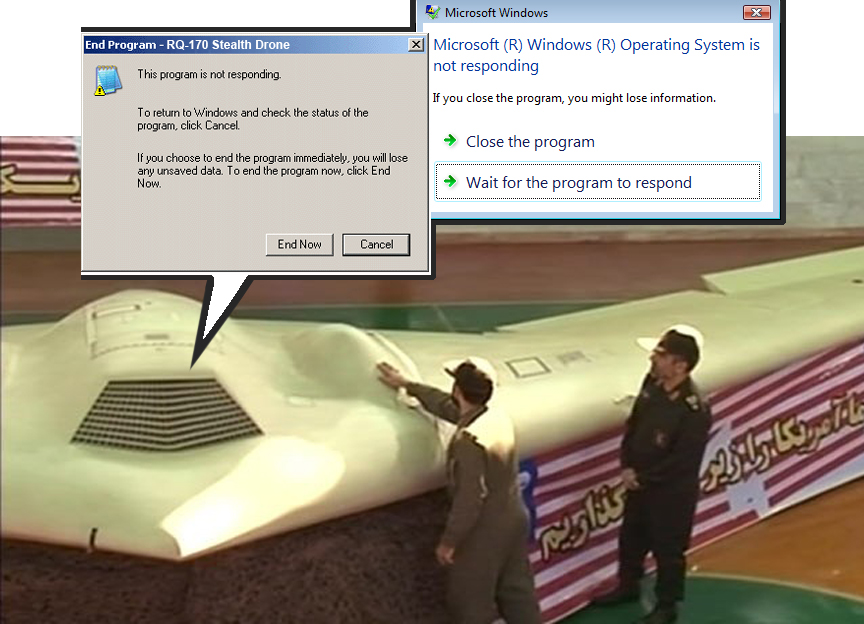
I hear the drone tried to convince the Iranians that it was only hiking.
I hear the drone tried to convince the Iranians that it was only hiking.
My stainless steel knives are beginning to throw rust spots in the dishwasher. While searching for a solution to why this is suddenly happening, I stumbled across the following comical exchange (I’m relieved that I am not the only blade fanatic):
Jim:
Deep breath…this is the yuppiest thing ever to come out of my mouth:
How do I get (minor) rust off my Sabatier stainless steel bread knife?
Whew. It’s over. Time for a beer.
Caroline:
The only time I remember ever getting rust on my Sabatiers was when a housekeeper washed one by hand, then set it in a wet sink to dry with a carbon steel blade sitting on top. The rust just washed off with a wet sponge, but the former housekeeper is still on life support.
There are two kinds of truth: the truth that lights the way and the truth that warms the heart. The first of these is science, and the second is art. Neither is independent of the other or more important than the other. Without art science would be as useless as a pair of high forceps in the hands of a plumber. Without science art would become a crude mess of folklore and emotional quackery. The truth of art keeps science from becoming inhuman, and the truth of science keeps art from becoming ridiculous.
-Raymond Thornton Chandler, writer (1888-1959)
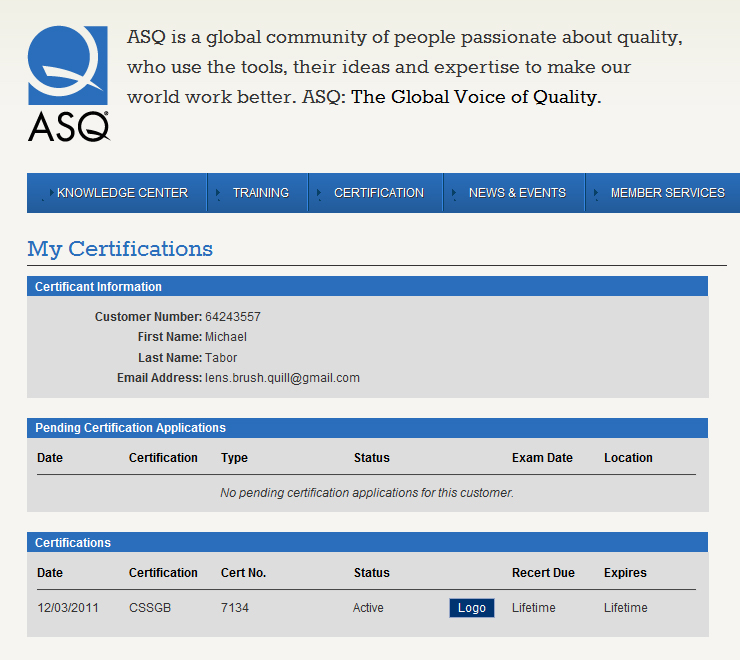
Attention: Michael Tabor
Re: 12/03/2011 SSGB Exam Results
“Congratulations! We are pleased to inform you that you have passed the ASQ SSGB examination.”

…but I’m relieved it did. 😀
For the uninitiated, Six Sigma is a business management strategy originally developed by Motorola in 1986, and is now widely used in many sectors of industry.
Six Sigma seeks to improve the quality of processes by identifying and removing the causes of defects (errors) and minimizing variability in manufacturing and business processes using a set of quality management tools, including statistical methods. This is accomplished in a defined sequence of steps with quantified financial targets (cost reduction and/or profit increase).
The term Six Sigma originated from terminology associated with manufacturing, specifically terms associated with statistical modeling of manufacturing processes. The maturity of a manufacturing process can be described by a sigma rating indicating its yield, or the percentage of defect-free products it creates. A six sigma process is one in which 99.99966% of the products manufactured are statistically expected to be free of defects (3.4 defects per million opportunities). Motorola set a goal of “six sigma” for all of its manufacturing operations, and this goal became a byword for the management and engineering practices used to achieve it.
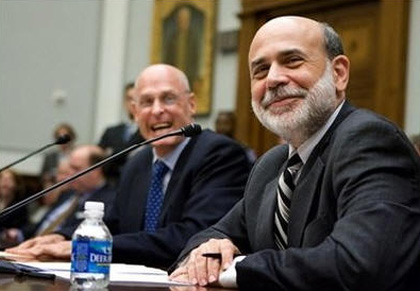 The Federal Reserve and the big banks fought for more than two years to keep details of the largest bailout in U.S. history a secret. Now, you can see what they were hiding. Be sure to roll the interactive tool across the graph – it shows who benefited, and by how much.
The Fed hid the facts about which banks were so badly overextended (“insolvent”) that they required a combined $1.2 trillion on Dec. 5, 2008. Predictably, banksters lied, assuring investors their firms were healthy while hiding the fact that they took billions of dollars in taxpayer-funded emergency loans. And no one calculated until now that banks reaped an estimated $13 billion of income by taking advantage of the Fed’s below-market rates. In spite of that unjust enrichment, they refuse to consider Principal Reduction as an option to alleviate the housing crisis. [In her article, Principal Reduction Will Solve The Housing Crisis and Jumpstart The Economy, Tanya Marchiol presents a compelling argument for the win-win solution principal reduction presents.]
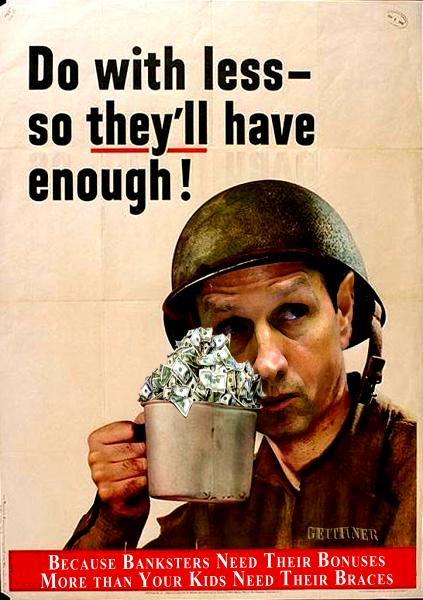 Saved by the bailout, banksters lobbied against government regulations, abetted by the Fed, which withheld the details of the rescue to lawmakers even as Congress doled out more money and debated new rules aimed at preventing the next collapse. Lawmakers had no clue that one bank, New York-based Morgan Stanley, took $107 billion in Fed loans in September 2008, enough to pay off one-tenth of the country’s delinquent mortgages. The firm’s peak borrowing occurred the same day Congress rejected the proposed TARP bill, triggering the biggest point drop ever in the Dow Jones Industrial Average. The bill later passed, and Morgan Stanley got $10 billion of TARP funds, though Paulson said publicly that only “healthy institutions” were eligible.
A fresh narrative of the financial crisis of 2007 to 2009 emerges from 29,000 pages of Fed documents obtained under the Freedom of Information Act and central bank records of more than 21,000 transactions. While Fed officials say that almost all of the loans were repaid and there have been no losses, when guarantees and lending limits are considered, the Fed committed $7.77 trillion as of March 2009 to rescuing the financial system, more than half the value of everything produced in the U.S. that year.
No one on Wall Street or on the board of the lenders that perpetrated these manifold frauds have been prosecuted, and Americans continue to be consumed with the clown car of election politicking. Nothing of real value or consequence to the quality of life in our country is being discussed in the Corporate Media, and particularly not in the “debates.”
Meanwhile, we continue to struggle to cope with the theft of 20% to 30% of our personal resources, and services diminished by the siphoning of public finds by MegaCorp.
The presence of an observer influences the outcome of events, and often defines the way events will be seen. And the presence of a reporter, along with the selection process of editorial staff, will determine how that event will be revealed to the public.
As “news” media has become completely subsumed into the larger media profit center, photographers and reporters are often under deadline pressure to present something their editors can use in upcoming press. In the absence of action, sometimes the truth is stretched or embellished.
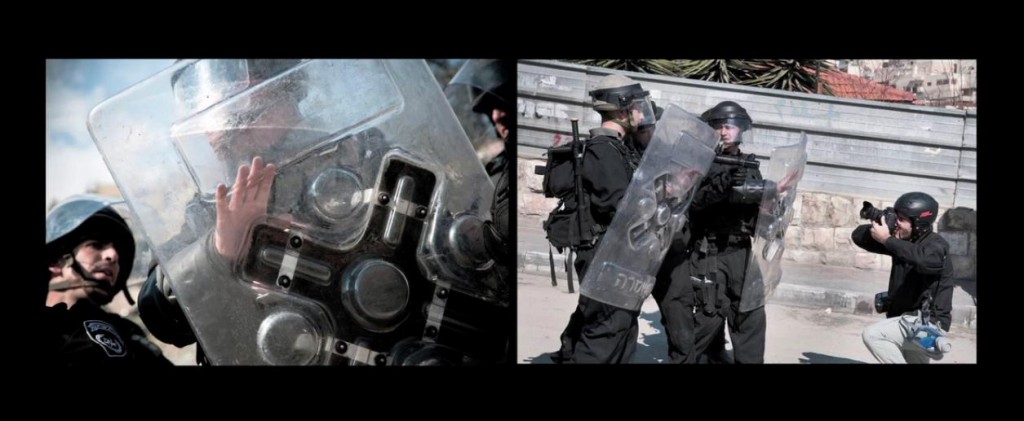 This link will take you to a 9 minute video of Ruben Salvadori‘s presentation of “Photojournalism Behind the Scenes,” a critical photo-essay considering the role of photographers in the events they are covering.
Here is a related article which describes the video and Salvadori in more detail.
I do not believe for a second that this presentation will change anything (due to the corrupting influence of corporate profit motives), but I’m thrilled to see someone has the intestinal fortitude to discuss this topic with appropriate documentation and sobriety. Ruben is only 22.
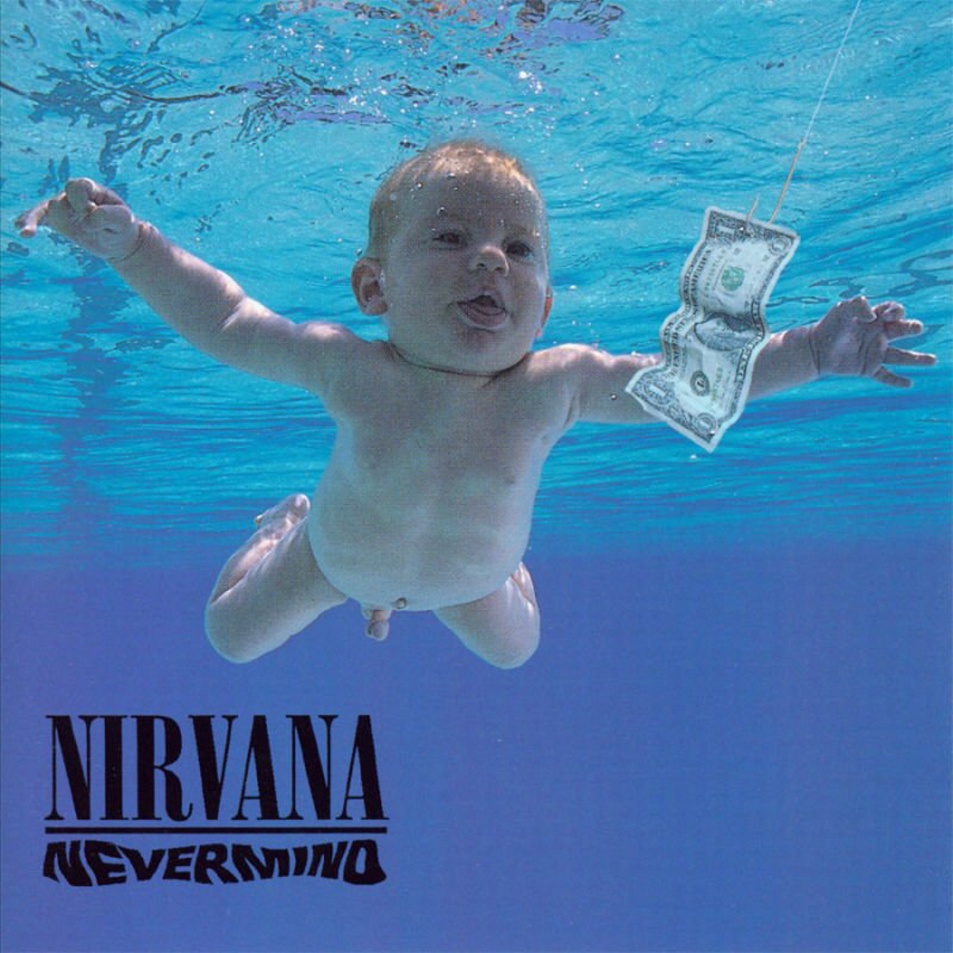 Nirvana’s iconic album, “Nevermind” turns 20 this year. Just as iconic as the music is the album’s cover, a shot of a naked infant floating toward a fishhook baited with a dollar bill.
At the EMP, the “Nirvana: Taking Punk to the Masses” exhibit is running, and you can check out the original photo for the cover, with handwritten notes in the border written by an art director.
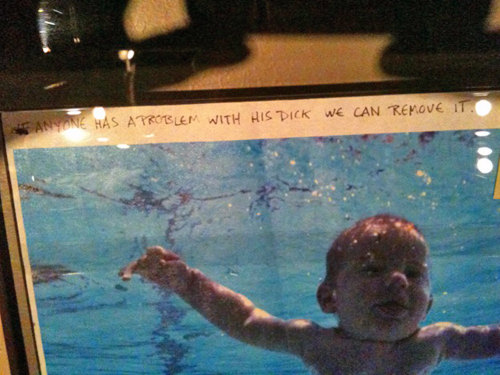 One of these notes explains that the bottom of the swimming pool can be airbrushed out, which it was, and there is an additional note in the top border: “If anyone has a problem with his dick we can remove it.” Famously, that element was not removed, to the chagrin of the baby, Spencer Elden, who turned 16 recently. “Everyone out there in the world has seen my penis already, my baby penis.”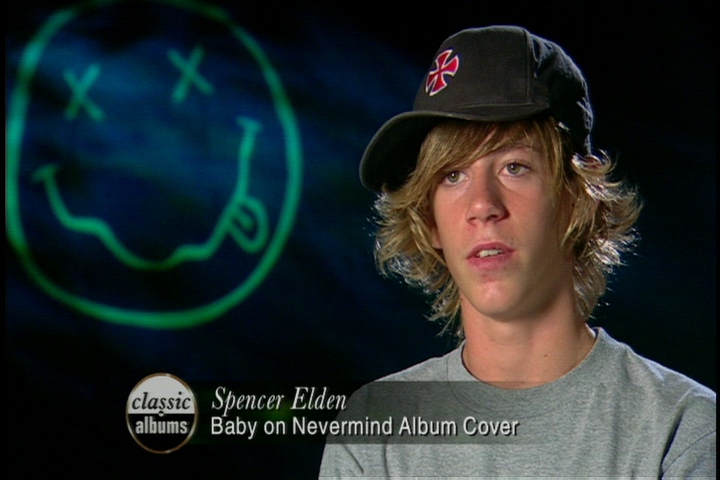
Kurt Cobain turned to photographer Kurt Weddle who knew the Elden’s, who allowed Spencer to be photographed for around $200. I have read that the dollar, hook and line were added later.
(Click on the photos to see them larger.)
Love feels no burden, thinks nothing of trouble, attempts what is above its strength, pleads no excuse of impossibility; for it thinks all things lawful for itself, and all things possible.
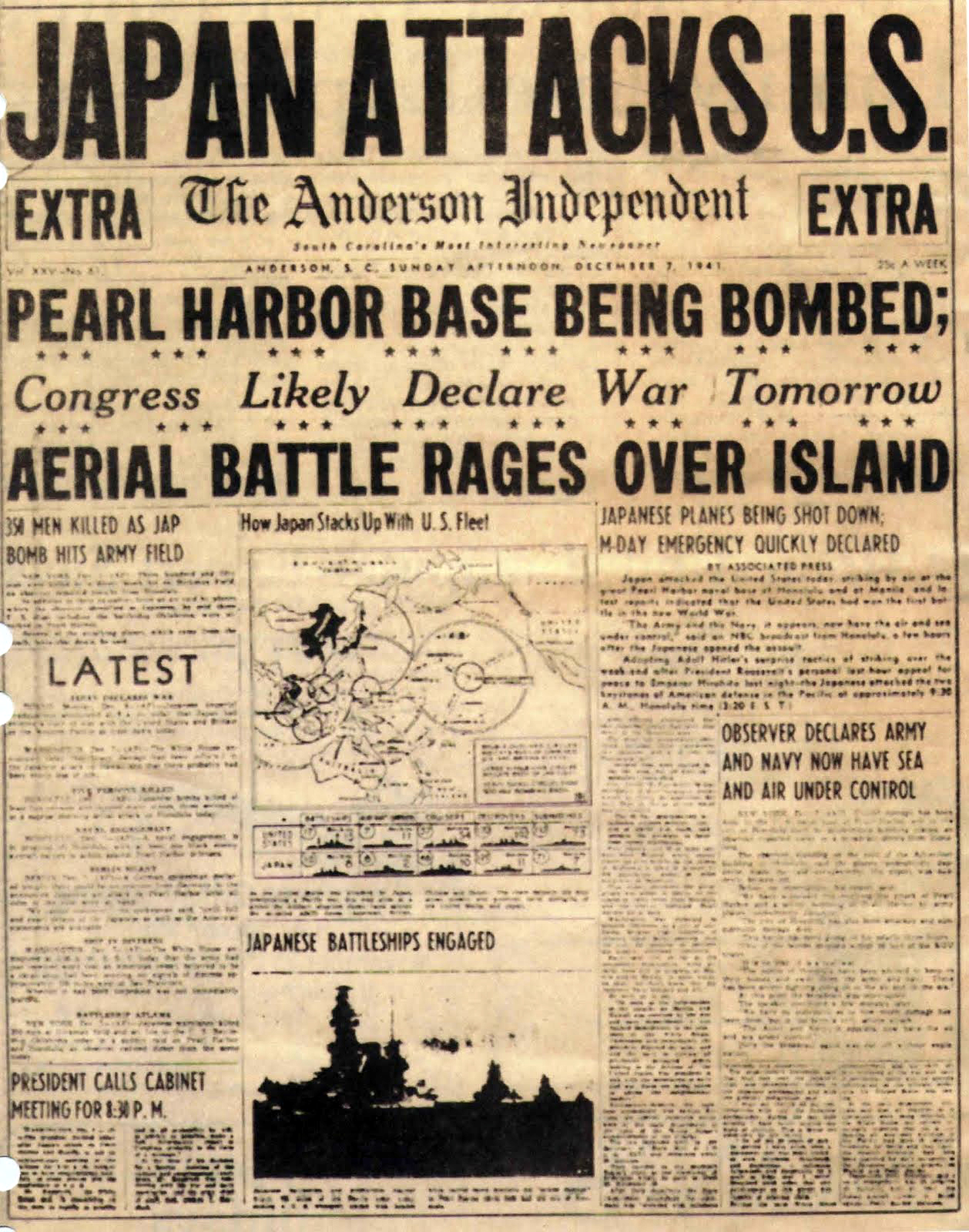
Overall, nine ships of the U.S. fleet were sunk and 21 ships were severely damaged. Three of the 21 would be irreparable. The overall death toll reached 2,403, including 68 civilians, and 1,178 injured. Of the military personnel lost at Pearl Harbor, 1,177 were from the Arizona.
On August 23, 1994, United States Congress designated December 7 of each year as National Pearl Harbor Remembrance Day.
Because I have been so vocal in my criticism of the CSSGB test that we took on Saturday, I’m making an equally public statement admitting that apparently, I was wrong about a few important things.
I love learning new things, and I generally have little trouble assimilating and applying new information. With adequate preparation, I usually test well. So when I leave a test that seems to be testing for something other than the topic I’ve just spent 12 weeks immersed in, it freaks me out. I was convinced the test had validity problems.
Maybe not.
ASQ certification exams use a “cut-score” process. It takes 550 points out of a possible 750 (approximately 73%) to pass. The Cut Score Process determines the passing score, and Scaled Scoring allows adjustments for exam difficulty on subsequent forms of the test. To oversimplify, the cut point for a passing grade is determined by a panel of twelve to fifteen subject matter experts, who select test questions by the criteria that eighty to ninety percent of qualified SSGBs should know the correct answer. Scaling is accomplished by “equating,” in which older questions and new questions are included in the exam. The mean student scores for the older questions are compared to the current test scores as an indicator of the current test difficulty, and the test is “scaled” accordingly. In other words, “If [candidates] get a hard test, they won’t have to get as many questions right to meet the standard. If they get an easy test, they will have to get more of those easy questions right in order to meet the standard.” The complete explanation for the test development and scoring processes is here.
I can attest that there were a few questions included in our exam that were very close to questions in the Primer, but what about those infernal nonsense questions that have multiple correct answers? Questions that were not only unfamiliar, but defied my intuition and logic? From Govind Ramu’s article, “Test Run: Improve Your Chances of Passing an ASQ Certification Exam,” I draw a clue: “The questions require application of knowledge and experience.” Added to the cut process, where questions are selected by SMEs to reflect the body of knowledge possessed by active practitioners, it is clear that students like Kay and Mark, who have real world experiences with which to anchor these principles, are at an advantage. Those are the students ASQ is seeking for certification.
Students like me, with far less concrete experience in QC and faded memories of statistical and algebraic principles, are at a disadvantage. Beyond my personal limitations, I think that the classes we took together are more accurately described as review. In my degree studies, I spent an entire semester on SPC (Statistical Process Control) – which we did not even get to in LSS Advanced Topics because we ran out of time. It also seems to me that we did not have nearly enough practical application of concepts.
For instance, it would have been useful to have more problems that illustrated various ways data can be presented to a CSSGB, and how to properly select the correct distribution or chart to analyze those data. Of course, I understand the resistance to spending an additional $400 and another six weeks on yet another course. But I think the presentation of additional practical applications would significantly improve student comprehension. After twelve weeks of focused study, my single biggest problem is this: when I am presented with data, as in the test questions, I often don’t know what I am looking at. What formula or distribution am I expected to use? Only experience and/or additional instruction will cure that problem.
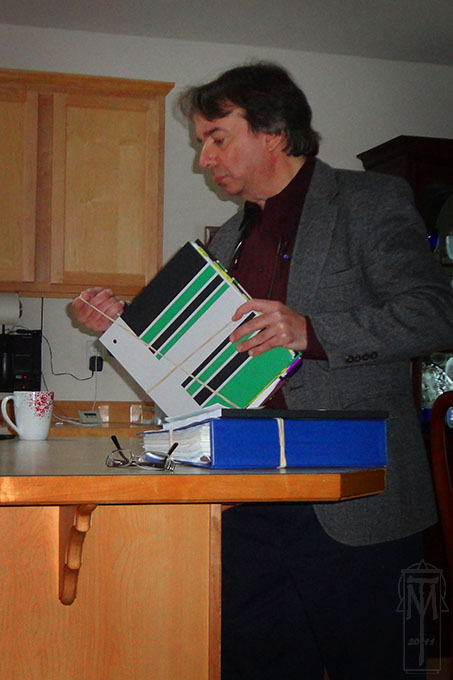 The range and amount of typographical and content errors in the handbook did not help, nor did the differences between the handbook and the Primer. There were two different editions of the handbook among our class bearing identical ISBN, publication and edition numbers, but containing different content. It is beyond ironic for a textbook with quality control as a topic to have so much errata – it is outrageous. But I also confess that my reaction to this might be exaggerated because of my frustration with the obstacle to learning those discrepancies presented. After a few weeks have passed, I’ll get the book out again and see if I still feel the same way.
And of course, you gotta love test questions that test your ability to see through legerdemain, not your grasp of statistics. Or questions that are based on the subjective judgment of the author. And there is something patently ridiculous about testing people about their ability to calculate variances on a calculator. Yes. A freaking calculator. As in grammar school. Using a calculator in this type of exam tests my ability to avoid fat-fingering the entries, not so much my ability to derive descriptive statistics. The only time you need a calculator in Quality World is when you sit for one of these tests, because everyone in the real world loads their data into excel or Minitab and presses “enter.” Strangely, my TI-68, purchased in 1989, was disallowed by a proctor. Fortunately, I expected the worst and brought two calculators. One by TI, the other by Fisher Price.
I wish that I had known, before I spent two grand that I did not have, that certification requires more practical experience, and that I had really taken the time to figure out that this set of courses is inadequate preparation for certification. Mind you, there was no deceit here: Katharina said more than once that the courses at EvCC are not intended to be preparation for the exam. I saw the course listings for something that keeps appearing in listings for jobs I want to apply for, and I got excited about the prospect of adding that credential to my resume. It’s that simple.
Having said all of that, I have come to genuinely care for my fellow students and instructors. I enjoyed their company and camaraderie, and I dearly hope that I left everyone with something of value as well. It was all time and money well spent in a broader way – I made valuable acquaintances and learned a number of things that have application to my life in unexpected ways. For example, the 5S principles have enabled me to focus on some elements of personal organization that have eluded me since I moved to the PNW. And being reacquainted with algebra and stats has given me a wakeup call about how much facility I have lost in those areas.
To think that once upon a time, I actually passed calculus. After I completed the exam, I went back over all the questions, and changed twelve answers. So if my previous history with exams holds true, my best possible score is less than 85%. Right now, you should have a mental image of me, head bowed in a face palm, groaning softly.
The test is over. 100 multiple choice questions, open book. Not a cake walk. For the first time in my life, I used all the available time (four hours), and still came away feeling uncertain about my score.

Our LSS instructor, Katharina, gave us some cash to buy a round after the test, but we opted for brunch instead. We stepped over to the Hangar Cafe in Georgetown. (It’s a single family residence converted into a restaurant, so the eating space is about as big as my living room. Very cozy, and the food was excellent!) Over crepes, we compared notes about some of the test questions, and predictably, there were a few I now know I missed. Of course, this became blindingly obvious now that it was too late to do anything about it.
Left to right at the Hangar Cafe: Chris, Mister Esprit d’escalier, Dan, and Ha.
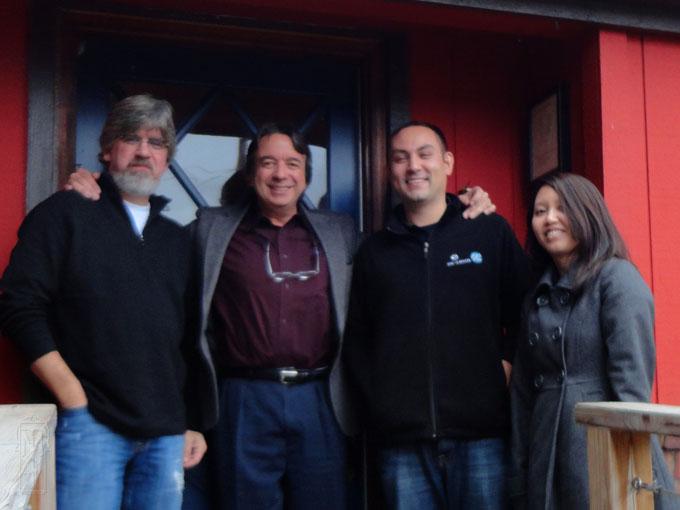 After twelve weeks of classes together, I’m really going to miss these good people!
I think I can safely speak for all of us – it would have been great to have Katharina with us at the “autopsy,” but I understand how impractical that would have been. We appreciate her uncommon kindness and unflagging encouragement.
This is the last week of cramming for the Lean Six Sigma exam on Saturday morning. I have been using an Exam CD with 1,000 example questions from previous exams, such as: “The shift supervisor smokes Camels, the press operator is changing her tampon. Venus is in Ares, Jupiter is in Taurus. What will the variance be on the third Thursday after the next Lent moon?”
OK, I exaggerate, but not by much. An actual question:
“An experiment yielded the following equation: Y=14.0 + 12.7 X1 + 16.1 X2 + 9.8 X2 + 6.4 X1 X2 What CANNOT be said about the response surface?” (Answer: It contains more than a 3-D picture.) I am not optimistic about my probability for success.
Not too many of us left in the LSS Advanced Topics class, as we near the finish line:
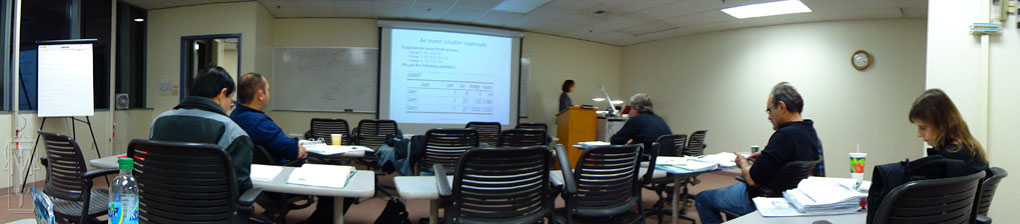
Some people, like Dan the math major here, are unflappable and permanently good humored. He seems to have a definite leg up:
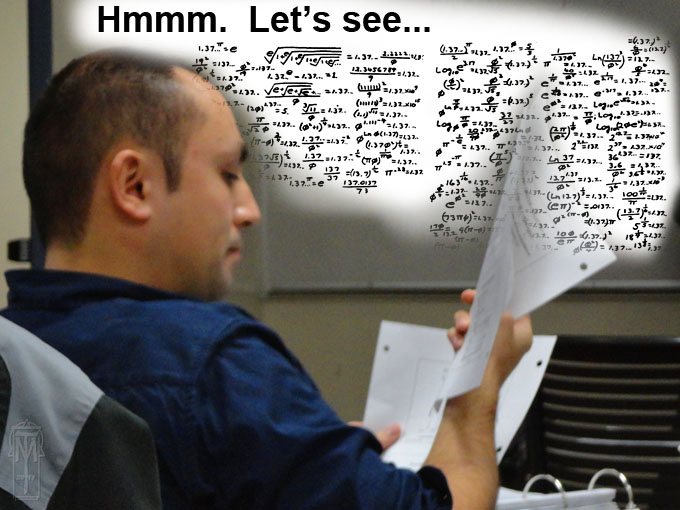
Meanwhile, the rest of us are struggling along:
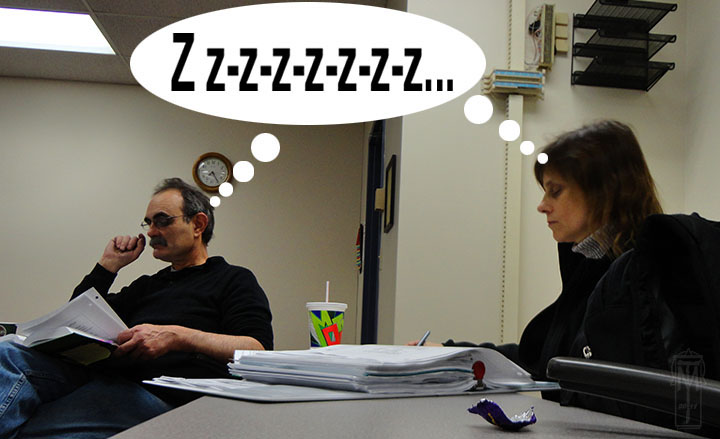 Seriously, I don’t know how people can work their butts off for a full shift, then come and sit for three hours of stats. No matter how competent, comely or charming the instructor, this is truly a tall order. If I were still writing 30,000 word narrative reports, there is NO WAY I could have kept up with the work.
 Risk of employment or income fraud on mortgages increased 8.8% in the third quarter from the previous quarter and 50% from third quarter 2009, according to research firm Interthinx. Its general Mortgage Fraud Risk Index remained virtually unchanged for the quarter at 143, down 0.1% from a year ago and up 0.9% from the second quarter.
The Stockton, Calif., metropolitan area had the highest risk index at 303, followed by fellow California metros of Modesto (299) and Bakersfield (277). (A score of 100 represents a nominal level of fraud risk.)
By state, Nevada’s score of 255 ranked highest, followed by Arizona at 243 and California at 197.
Last night, the local news led with (cue dramatic music and graphics) “The Perfect Storm!” I rolled my eyes and groaned. ‘Holy Shit everybody! It’s going to RAIN tomorrow! And there will be wind, too!” Can’t these freaking people just report things without hyperbole and histrionics? What the hell are they going to do when, say, another midlatitude typhoon plows into the NW coast? They’re going to be completely out of superlatives!
This morning, swarms of “reporters” are zooming around, trying to beat each other to get a photograph of the one tree that has fallen over in someone’s yard, or maybe a car that has broken down along the road, or – media gold – something going on with emergency vehicles that have their pretty red lights flashing! (Woooo! Lookit the purty colors! Woooo-Weeeeee!)
(Breathlessly:) “There’s seven miles of brake lights northbound into downtown Seattle!” Guess what, you moron! It is like that EVERY TIME IT RAINS, because Seattlites lose all their driving abilities in the rain! All the choppers are in the air (from all three local stations), searching for any car accident they can find, and I just looked up to see a brave “reporter” standing in a puddle (Yes! A goddamned puddle!), hand wringing over the possibility of storm drains being choked by leaves. “It’s going to get windier as the morning progresses, so be sure to check in with us again as we track the progress of this storm!”
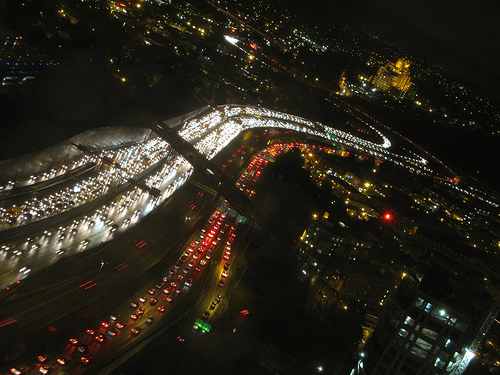 Ummmm… I think not. The only reason I turned the TV on was to see if there was actually anything important I should know. As in, actual news that has a direct impact on how I decide to plan my day. The same thing went on in Buffalo, when Irv Weinstein would intone his baritone alliterative warnings about approaching snow: “Coming up next: Canadian air packing a powerful punch approaching!” Buffalonians would reflexively drop their Genny’s and leap into panicked action to clear the supermarket shelves in two hours flat. I swear to god – it had to be a conspiracy between the local media and the store owners.
But at least they could actually predict weather in Buffalo. In all of the places I’ve been in the US, the Pacific Northwest consistently has the WORST weather prediction. How many times have the local weather “personalities” predicted foul weather for the next day, and it turned out to be sunny and mild? Or vice versa? The human mind cannot comprehend a number so large. “Seattle weatherperson” is truly an occupation to seek if you do not want to be held accountable based on your performance.
All of this theater and worthless information is the logical, inevitable outcome of allowing the presentation of news – which should be a public service for the common benefit of our mutual safety and security – to become a profit center. The paragon of this operative model is the illegal actions of Rupert Murdoch’s Daily Fail (hacked email and phone accounts to spy on private citizens) and the presentation of opinions and outright lies as news by his propaganda center, Faux news.
These outlets are successful because they cater to our innate negativity bias, and because they have achieved sufficient wealth to demand changes in legislation that favor their unregulated profiteering (such as rules against concentration of ownership to prevent oligopoly). The annulment of the equal time provision of the 1934 Telecommunications Act (supplanted by the 1996 Telecommunications Act) paved the way for the hate media which prevents meaningful public discussion of what is truly important to our country, our culture, our collective well-being.
 Here’s a guy with a sense of humor!