For anyone interested, these two links [1] [2] from The Atlantic have some pretty good pix from the Costa Concordia wreck.
Additionally, here is a blog post about the possible methods that might allow the salvage of the Costa Concordia.
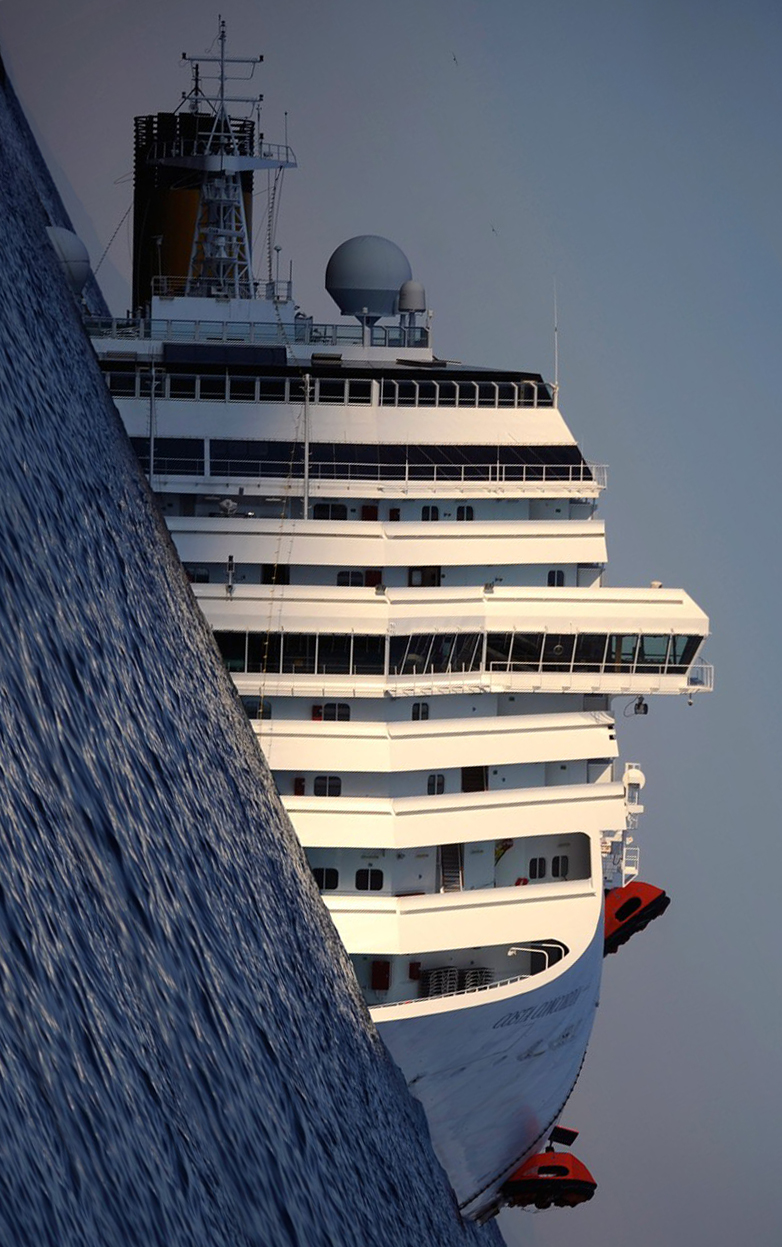
“Captain Skedaddle” is, of course, my reference to the alacrity with which Captain Francesco Schettino abandoned his charges and duties in what appears to be a modern benchmark for maritime cowardice.
Over the coming months, the buck will be passed so many times it will wear out in front of you. Analysis of Lloyd’s List Intelligence tracking data shows that Costa Concordia sailed within 230 m (755 feet) of the coast of Giglio Island on a previous voyage, slightly closer to the shore than where it subsequently hit rocks last Friday. But predictably, Costa Cruises (a subsidiary of Carnival Corporation & Plc.) insists Captain Schettino’s deviation from route was unauthorized. Costa Cruises needs to blame it on the Captain to limit their liability and losses, and Schettino needs to blame it on bad navigational data to save his career and his machismo.
Unfortunately, Costa Concordia passengers face a legal obstacle course. The 6,400 word contract incorporated in their cruise tickets imposes strict, non-negotiable compensation limits of $71,478 (£46,000) for bereavement and $500 (£322) for lost property, per passenger. Additionally, a vast array of items are explicitly excluded; including cameras, computers, contact lenses, CDs, mobile phones and even what is described in the contract as “dental hardware.” Legal action must be registered in Genoa, but passengers might be out of luck as Italy is not a signatory of the Athens Convention. In a nutshell – if you suffered losses here, your life is now going down the Amanda Knox rabbit hole of “Italian justice.”
One thing that has not received enough attention, but which I hope will become a focus of the official investigation, is the logistical challenge involved in evacuating four thousand people from a sinking vessel in the legally required thirty minutes. This is simply not possible with the new crop of “super cruisers” that can carry as many as 10,000 people (including crew).1 It is a physical impossibility to move 4,200 people from 15 decks out onto one or two decks to access lifeboats that have to be filled quickly, smoothly and completely without delay or imprecision. In other words, we have designed evacuation procedures as if they can be executed at six sigma levels of perfection, when the actual participant is likely to be untrained, disoriented, confused, physically compromised and in a panic.2
I was on the MS Statendam3 when it was almost new, and we had barely gotten on board when there was a ship-wide emergency drill to explain where the lifeboats were, how to use them, and what to do if something bad happened. Admittedly, it was a lot to absorb, and a bit confusing. At the time, I could not understand why there was no “settle in” time before we got the safety lecture. But it turns out this is actually a legal requirement, and in hindsight, a very good idea. Once you get “settled in,” you’re going to be a lot more concerned with your next Mai Tai than the location of a lifeboat you are certain you will never need. Cruise providers have to thread a fine line between the need to bring passengers face to face with all the trappings and procedures that remind everyone solidly of the proximity of mortality and disaster, while at the same time trying to welcome them to an environment created to erase all their cares and concerns.
The fact is that when things go wrong, it is almost always a cascade of contributory factors that accelerate with aggregation. And most of that cascade will be invisible to passengers – by design. Suddenly, the klaxon is going off, and you’re trying to understand distorted instructions blaring out of the cheapest horns the shipbuilder could find, and this through the haze of being half asleep, or worse – shitfaced. The deck is unstable and moving, adding to your disorientation and confusion. And once a ship is listing by fifteen degrees, it is impossible to launch lifeboats – on the downward side, they swing free of the ship and cannot be boarded, on the upward side, they snag along the side of the ship and cannot be lowered.4 Not to mention the fact that you might very well find it absolutely impossible to climb up a steeply tilted smooth deck away from flooding frigid water, while dodging falling debris and other people, in order to reach your assigned evacuation point.
Any maritime situation that can cause listing has the potential to eliminate the primary evacuation routes and to trap people below decks. New solutions and technologies are needed, and safety protocols rigidly enforced, in order to prevent loss of life in what will inevitably happen in future mishaps.
There is no such thing as an unsinkable ship.
There is no such thing as a perfect Captain and crew.
1. The Allure of the Seas, built in 2010, can carry 6,390 passengers with 2,246 crew. The trend toward building massive cruise liners is driven by economies of scale: the more people you can jam aboard, the lower your cost per passenger, and the higher your return on investment ratio.
2. A look into the chaos that reigned after the hull breach is glimpsed in statements of survivors: “The evacuation of the ship was completely chaotic. There was certainly no ‘women and children first’ policy. It was disgusting. …There were no emergency services and the cruise staff had all disappeared.” Source “When the boat started listing, all the corridors filled with water. They were like wells and there was a lot of people stuck in these wells. Using a rope, I started to pull people up. They were crying and were really scared. People were fighting with each other in order to get on the rope to climb up. …It was very difficult as there was some oil around, so climbing down the steps and on to the ladder was extremely slippery. For children and old people, it was especially difficult.” Source
3. Built in 1992, it carries 1,260 passengers, quaint by today’s standards. This is the ship I rode through Hurricane Gordon on the Sargasso Sea.
4. You can see this on the Concordia. In the image at the top of this post, lifeboats are clearly seen stranded high and dry on the side of the ship.
2 Responses to From Captain Skedaddle