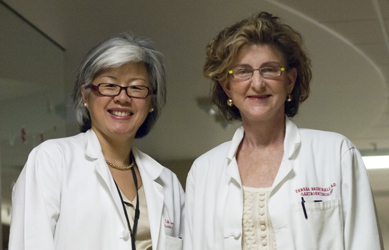
 At this year’s UW Mini Med School I had the opportunity to attend a Gross Anatomy lab. (Right: our hosts, Dr. Cheng and Dr. Brentnall),
The lab had six cadavers on gurneys, wrapped in a heavy fabric in body bags, with each attended by a medical student who would explain to us the primary features of internal organs and processes. Everyone snapped on Nitrile gloves and ten of us from the lecture series lined up along each gurney for the unveiling. The stench of formaldehyde was very strong, but in about 15 minutes, I was pretty much over it. Olfactory fatigue is my friend. 😀
On the “Wow Factor” scale, the experience was right up at the top. Hundreds of little factoids and vague concepts I had been holding in my head snapped into sharp focus, and I learned so many new things!
In no particular order:
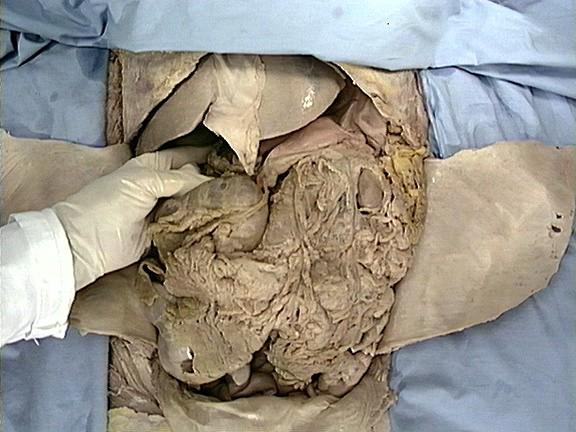 Δ After embalming, we all look like cooked turkey inside.
Δ I learned basic anatomy from textbooks, where everything is depicted in A-B-C easy colors and as discrete components. Inside, there is no empty space (nature really does abhor a vacuum, it seems), so each organ bears the imprint of its neighbor: the lungs are creased from the rib cage, the esophagus has a smooth furrow where the aorta carried 50 million gallons of blood to everything you called your own, the left lung is a little smaller because of the pericardium.
Δ With the range of things that can go wrong, and the interdependence of internal organs, physicians are deliberately vague when discussing your symptoms. There’s no point in telling you that an aortal aneurism is one of the possible causes for your difficulty swallowing (the aorta runs alongside the esophagus) – thereby sending you into a panic – until there is more data from which to make a more solid assessment.
Δ Each of us are fundamentally the same, but each cadaver was different enough inside that I still am not sure how any health care professional ever manages to hit the subclavian vein with a C-line (central vein cannulation). Everything in anatomy is an approximation, which gives me new respect for emergency surgery, which must be a little like running into a burning room to find a fire extinguisher.
Δ The rectum stores fecal material in the same way the bladder stores urine, otherwise we’d never leave the bathroom.
Δ The lungs of typical urban dwellers look like they have been dusted with pepper – the residue of carbon and soot are accumulated and carried with us for our entire lives.
Δ Out of the body and inflated, the lungs are as light as a balloon. I was floored by this, as I held a pair of lungs that had been inflated and hardened in that position with resin.
Δ The natural tendency of the lungs is to contract into a mass approximately the size of both of your fists together (per lung), and are kept inflated by the dynamics of being in a sealed chamber. Which explains why the lungs can collapse if the chest wall is punctured – normal air pressure gets into the chest cavity, around the lungs, and they snap shut. The med student told us you can, with difficulty, reinflate a collapsed lung with a flap of duct tape over the (penetrating) wound site, but I am skeptical. Hopefully, I will never have to test that theorum.
Δ The right lung is the usual recipient of anything accidentally inhaled – such as your tongue piecing hardware when you are in a car crash, or the cola that was a little too bubbly and “went down the wrong pipe.” The reason is that the trachea forms a more or less straight line to the right lung, and bends for the left one. The fact that we choke as infrequently as we do is an amazing testament to the efficiency of the epiglottis slamming shut over the trachea on cue.
Δ Arteries, veins and nerves are distinguishable with experience. Arteries have much thicker walls because they carry blood under pressure. The aorta (the main blood vessel leaving the heart) has walls nearly an eighth inch thick, which gave me a new understanding of the force required to tear the aorta after, say, a catastrophic car accident.
Δ Veins are almost tissue paper thin, to the point that I am amazed they last the 75 – 100 years most of us use them. Nerves are ridiculously difficult to find, and are reminiscent of tiny tendons: white and fibrous, and very very thin.
Δ I held a human heart in my hands, and marveled at the difference in muscle thickness between chambers. The left ventricle is the thickest, as it does the majority of the work. I saw the remains of a pacemaker in one case, and artificial heart valves in another.
Δ I saw the vestigal remnants of the hole between the right and left atria, which are necessary when the fetus is still hooked up to the umbilicus, and the remnants of the vessels and nerve bundle running up under the liver that is no longer needed after birth. Sometimes that hole between heart chambers doesn’t heal itself, and surgery is needed for infants to patch it shut. It is incredible that we can even do that at all.
Δ Surgeons have a reputation for being callous, egotistical and abrupt, and the common nostrum is that this arises from repeated exposure to what the rest of us think of as carnage. Perhaps the truth is at times, a little deeper. Entering another person’s body – even when dead – is a singular act of intimacy, and if one lingers too long in the sacred gravity of that knowledge, the surefootedness certainty required for decisive action will evaporate.
Δ When I shared my experience in the lab, my dentist and my doctors talked to me at length about their recollections of Gross Anatomy labs when coming through school. Like combat or firefighting, this is a unique thing that has to be experienced to be understood, and everyone comes away with their own variation on our shared reality.
Δ Every “medical adventure” I’ve ever had – every surgery, every accident – is in sharp relief, and more clearly understood, now that I have been inside.
Δ If I ever get another chance to do this, I’ll leap at it!
Δ