As an eight year old, I remember walking along Porter Avenue in Buffalo with my father. We were talking about the weather, that I was interested in understanding it, and he told me that the proper name for the study of weather is “meteorology.”
He suggested we should stop at the public library, which was on our way home,[1] and I remember the startled look on the librarian’s face when asked for books about meteorology.
Part of the reading led me to folk expressions, adages, and “old-wives’ tales” regarding weather forecasting, many of which remain burned into my memory. One of them is “Mackerel sky, mackerel sky. Not long wet, not long dry.” Every time I look up and see altocumulus clouds scudding the sky, I know change is coming.[2]
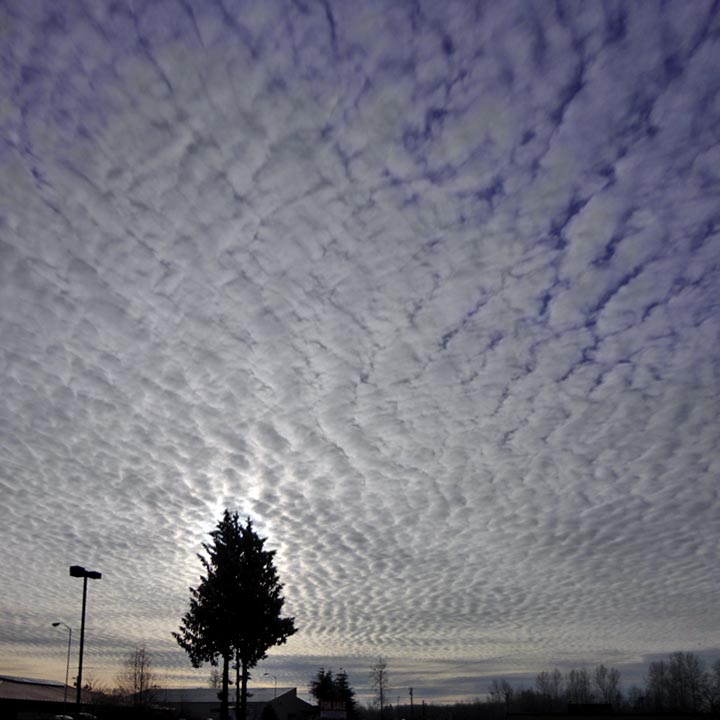 “Mare’s tails and mackerel scales / Make tall ships carry low sails.”
[1] Now called the Niagara Branch, at 280 Porter Avenue on the corner of Niagara Street.
[2] “A mackerel sky is an indicator of moisture (the cloud) and instability (the cirrus-cumulus form) at intermediate levels (2400–6100 m, 8000-20,000 ft). If the lower atmosphere is stable and no moist air moves in, the weather will most likely remain dry. However, moisture at lower levels combined with surface temperature instability can lead to rainshowers or thunderstorms should the rising moist air reach this layer. In the winter it is often said to precede snowstorms and flurries.”