Born this date in 1898. And we are certainly richer for it.
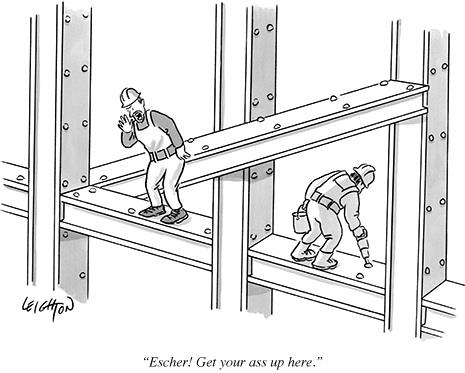
In late 1997, I went to see the centennial exhibition of Escher’s work at the National Gallery of Art in Washington D.C. It was the first time I discovered why it is important to see the originals of reproduced art. There was a great deal of nuance visible in the originals that do not show in the cheap lithos available at every art poster shop.
For example, I could see the slight bloom of ink into the paper – an almost imperceptible lack of sharpness that is inevitable when a person uses a quill on vellum. It made the art more “alive” and deeply moving, in that it was suddenly something done by another person, not something clever done by a machine.
Additionally, when viewing the originals, you get to see the actual size that the art was created. Escher’s “Metamorphosis” is twenty three feet long, and is even more stunning when you realize that it is a woodcut print.

Escher is a favorite of mine because his work combines perfectly the mechanical precision and geometric clarity that is associated with “left hemisphere” activities and professions, with brilliant distortions of reality that are the paragon of the cleverness that an energetic “trickster” mind can produce.