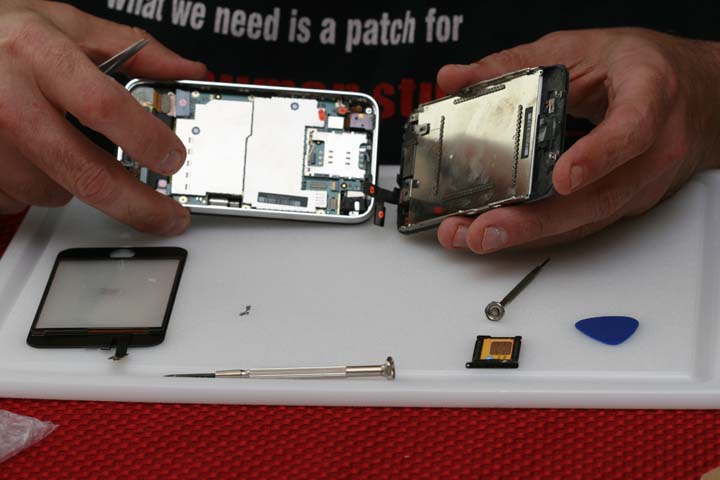
 Fortunately, I used to repair cameras. So when Camille dropped her phone, I was able to replace the broken touch screen. I still have my tools and loupe, and I am not yet so aged and decrepit that I can’t remember a long series of steps backward and forward.
Electronics continue to get smaller and more delicate, and the space between components inside the case has narrowed dramatically since the late 1980s, when I was a bench tech. In fact, I can see how things could be shorted out entirely in a crush incident of minimal force and deflection.
Or, in the case of the ribbon connector (bottom photo, on the penny), a small piece of dust or grit could prevent contact.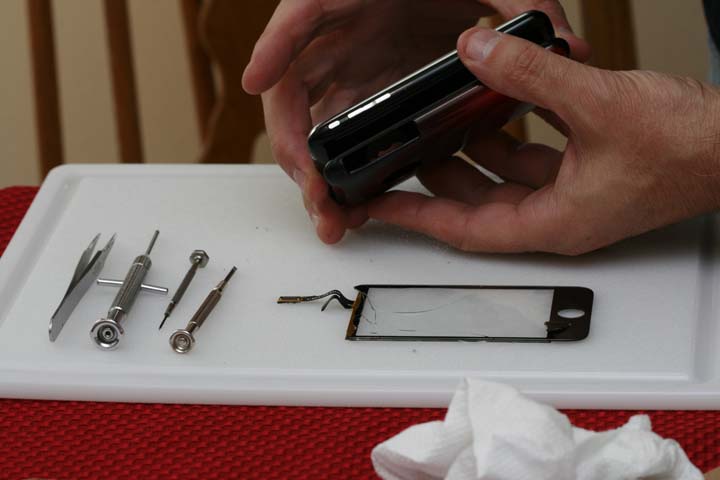
Of all the jobs I’ve done, this type of work is probably what I miss the most. It’s intense, requires ferocious concentration, a high degree of eye-hand coordination and manual dexterity, a high level of analytical and problem solving capabilities – but it does not pay well enough to live on. This is partly because economies of scale and market vectors make it much more cost efficient (for transnational Corporations) to encourage you to discard your electronics and buy the latest and greatest.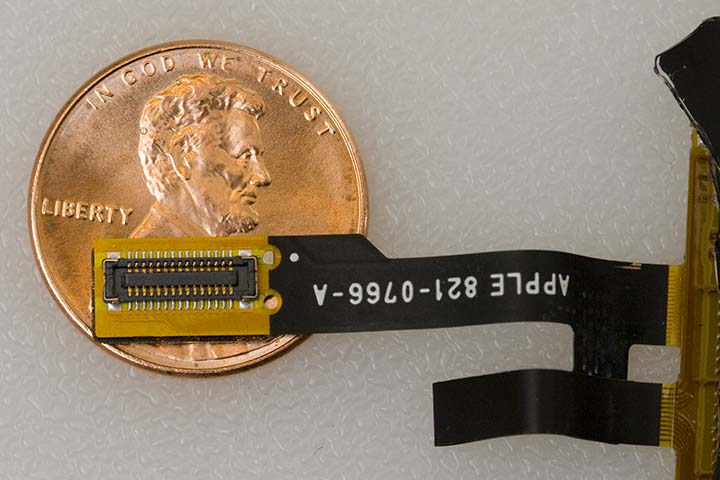
Remember, I am thoroughly old school. I was a “DIY” before the “Maker Movement” was invented. I developed and breadboarded my own circuits, designed my own furniture, clothes, guitars – and over the years made a few of all of these things. But the manufacture and development of new technology is now the product of multiple minds – the coordinated effort of many people working on a single overall product or goal. Much of what now surrounds us is too complicated to be designed completely by one person – specific areas of expertise now require an entire lifetime of learning to achieve some level of temporary mastery.1
The result is that advancements are made at an exponential, or hyper-parabolic rate.2 We’ve all experienced the frustration buying some piece of consumer electronics, and feeling betrayed by the manufacturer who introduces a far more advanced model a few months later. It is easy to take comfort in the narrative that there is a conspiracy toward selling us disposable products, forcing us to spend more money much sooner than we want to. But costs in electronic components have fallen a thousandfold in the last thirty years. If the same rate of change had occurred in the auto industry, you would be able to buy a car today for $5. Additionally, advancements in miniaturization, power capacity and junction speed have proceeded along the same curve.
We now have functioning motors and machines that are built from individual atoms, and nanotechnology is poised to begin making tremendous changes in medical care. It is perfectly reasonable to expect that we will one day be more machine than human, but not in a clumsy Borg kind of way.
Last year, I attended the UW “Mini-Med School,” and one of the topics was artificial skin used for burn victims.3 In my doctor’s office I read an article about nanobots, which are injected into the bloodstream and set about finding and destroying cancer cells,4 or precisely deliver drugs to the exact location they are needed for maximum efficacy.5
The biggest challenge for all of us, particularly those of us who have an acute and uncomfortable awareness of our advancing age, is to develop a constructive narrative that helps us make sense of the rate of change without unhealthy prejudice or fear.
Footnotes
[1] An excellent example of the turning point, when things became unmanageable for one man’s mind, was the maiden flight of the B-17. Oversimplifying, the pilot crashed after takeoff because a four-engine plane had become too complicated for one man to run without some sort of external assistance. This was the birthplace of the checklist. And that is a tale all its own, told with adroit mastery by Atul Gawande in “The Checklist Manifesto.”
[2] Moore’s law is the prediction that the size and capabilities (processing speed, memory capacity, sensors and even the number and size of pixels in digital cameras) will improve (roughly) exponential rates, doubling every 12 to 18 months.
[3] Patients who have lost more than 35% of their skin do not have enough healthy skin left over to “harvest” for grafts on their injuries.
[4] Cerofolini, G., Amato, P., Masserini, M., Mauri, G. (2010). “A Surveillance System for Early-Stage Diagnosis of Endogenous Diseases by Swarms of Nanobots”. Advanced Science Letters 3 (4): 345–352. doi:10.1166/asl.2010.1138.
[5] Yarin, A. L. (2010). “Nanofibers, nanofluidics, nanoparticles and nanobots for drug and protein delivery systems”. Scientia Pharmaceutica Central European Symposium on Pharmaceutical Technology 78 (3): 542. doi:10.3797/scipharm.cespt.8.L02.
And Patel, G. M., Patel, G. C., Patel, R. B., Patel, J. K., Patel, M. (2010). “Nanorobot: A versatile tool in nanomedicine”. Journal of Drug Targeting 14 (2): 63–67. doi:10.1080/10611860600612862. PMID 16608733.