I recently had an email exchange with a close friend of mine about cameras and drop damage that might be interesting to more of my friends.
April:
You said, “The number one reason, far and away, for camera repair is… (drum roll!) drop damage!” Can you give a casual estimate (percentage) from your past experience on Drop Damage?
Michael:
At least two thirds (Over 60%) of the repairs I did were to repair some form of drop damage. The most amusing were the cases where a customer would come into the shop and feign complete ignorance: “I have no idea what happened – the camera just stopped working!”
I’d take it up to the bench, pull the top cover off and find a bash mark so severe that the top of the pentaprism was chipped off, and the flexible circuit board was sheared in two. Because all the exterior covers are now plastic, they bounce back to their original shape, masking the severity of the damage to underlying parts that are not as flexible or elastic. So, you can have a camera that looks just fine on the exterior, but is completely dead in the water due to severe internal damage.
About 20% of the cameras I repaired were damaged by people forcing them. For example, insisting on getting just one more frame at the end of a 35mm cassette, or driving the 1/4-20 tripod screw deep into the bottom of the mirror cage, destroying the advance mechanisms.
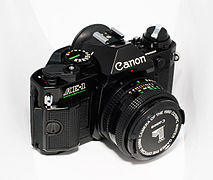 I worked on cameras that had been dropped into toilets, dishwater, and down storm sewer grates. I bought one that had been in the trunk of a TransAm that went into a tree, its lens had been driven all the way into the mirror cage by the impact. I bought that camera, a Canon AE-1 Program, from the owner for $20, and rebuilt it over time. I still have it, it has made over 50,000 exposures, and it still works beautifully.
April:
What percentage of the repairs were “Severe”?
Michael:
I’m thinking that “Severe” is probably defined by most people as the cost to repair.
The vast majority of cameras I worked on were not what I considered “severe,” but any damage that forces you to send the camera in for repair is expensive because there is a minimum bench charge. Today it begins at approximately $150, depending upon the camera model. At that rate, you probably could – and should – buy a new camera.
When a camera came to my repair bench that was, say, dropped out of a car window on the Expressway by someone trying to make an artsy image over the hood of the car they were riding in, we usually advised the customer to throw it away and buy something new. In those cases, our repair estimates were very compelling, because truthfully, the cost to pay a technician to sit at a bench and painstakingly rebuild everything by hand is going to be far higher than simply buying a new camera.
Additionally, technology is changing so rapidly that any camera you’ve had for more than six months is probably already a relic.
 I once had a job documenting the construction of the Marine Midland Atrium. While it was still open ironwork, I dropped my Canon A-1 off the fifth floor. I was incredibly lucky – it fell into a stack of 2×4 frames of tightly stretched plastic sheeting that broke the fall, so there was no damage. Up until that time, I had a great deal of confidence in my ability to hang on to my camera, but after that, the camera ALWAYS has a strap, and I still ALWAYS loop it over my head, even if the camera is mounted on a tripod.
If I walk away from the tripod, I loop the strap around the tripod, because I have a Bogen with a quick release mechanism that has failed in the past. (That’s how I dropped the A-1 back in 1989).
People can laugh at my “belt and suspenders” approach, but I’ve never dropped a camera since.
April:
Sort of like the old Dog Ate My Homework excuse on the “I don’t Know What Happened.”
I spoke to a guy who works at the Best Buy returns department, and as you know, it’s the era of Disposability. He said that the biggest issue with the Point & Shoots is customers trying to jam batteries in backwards and breaking off the clip/microswitch that holds the battery in. He says people will not read the manual, or even try via some semblance of intelligence to flip the battery around.
On the DSLRs that still take Compact Flash cards, the main complaint is bent pins. The CF card is just gentle slide in and stop, and the pins will easily find the holes in the cards. But if there is any angle of play whatsoever, people will find it, and try to force the card in on an angle. The big box stores and the Targets are not equipped to handle repairs at all, so it sometimes goes into some kind of “mfr return limbo box.” But in the cases of severe stupidity, the customer is told to send it back to the manufacturer as what they did was obviously not covered by warranty.
He says they can sometimes skate by on the point & shoots with a “defect” categorization, and then he has to go into a whole instructional spiel about how to install a battery and card. They absolutely hate seeing someone walk in with a camera box in a bag because it is almost always going to be ugly.
The number one rule of modern electronics needs to be widely published: if it does not ease in with gentle, even pressure, it’s not supposed to go in that way.
One Response to Drop Damage